

Where Life Began: ‘Warm Pools?’ ‘Black Smokers?’
(Essay #15, at 6-23-25)
This is also the fourth of four (#12 to #15) interrelated Essays on Earth’s geochemical origin of life. Here are the titles of those four Essays:
Essay #12 — Chemical Precursors to Life on Earth
Essay #13 — The Organic Molecules & Processes that Form Life
Essay #14 — Abiogenesis: Evolution of the First Life on Earth
Essay #15 — Where Life Began: Warm Pools? Black Smokers? (the Essay you are reading now)
An earlier Essay, “The Processes of Evolution & Their Meaning,” is just as important as the “biological four” Essays listed above because it describes the evolution happening all around us, here and now, in three arenas: biology, culture, & technology. It takes all five Essays to fully explain how the processes of evolution provide us with our complete human sense of, and appreciation for, Evolution’s connectedness & meaning based on Nature, Science, & History.
Note: Some readers may have elected to skip sections of our Essays #12 and #13, which were technical in several areas. However, like Essay #14, Essay #15 recounts lively stories of dramatic Life Creation in perilous locations.
So far, we’ve only discussed evolutionary paths that were likely to have been followed in creating the precursors for life, e.g., the Four Key Molecules. But gathering those precursors together does not necessarily mean that they will all function together to do enclosure, respiration, metabolism, and replication. Protocells might only do three of the four, or protocells might perform all four, in primitive ways. In other words, the earliest protocells may have been more akin to chemical systems than living systems. 1
How did we get just the correct sequences of physics, geology, and chemistry to produce a functional “First Organism?” What sort of general (and local) environment was required? What materials were needed to be on hand? What kind of energy supply? What temperature and what pressure?
There is not much evidence about how Life got from amino acids free-floating in water to the first single-celled, membrane-enclosed proto-bacteria (or proto-archaea), but there are several models (hypotheses) describing where and how First Life was “put together.” Each model has significant support in the scientific community.
One thing all the models will show us is that early life was highly adaptable. Life is a strong seeker, a powerful explorer. Life finds a way! Not always, but often, and if not often, often enough! This remarkable adaptability has resulted in an incredible diversity of single-celled life forms and portends an even greater abundance of diversity in the realms of multicellular plant and animal life, as we shall see in our (as yet unwritten) Essay.
“Extremophiles”- Microbes Living in Harsh Environments
Before we look at the eight models of Where Life Began, consider where present-day archaea and bacteria are now living. Since they are the simplest organisms we have today, perhaps First Life originated in one (or more) of these environments.
What we find is that modern microbes live in virtually all of Earth’s environments today. And since “all” of our environments include some extremely harsh ones, we need to examine those, primarily since life most likely originated in the early Archaean Eon, when Earth’s intense volcanic activity produced tremendous heat and subterranean pressure.
In fact, most chemotrophs (including the ones we discussed earlier that consume inorganic elements like sulfur and iron) are “extremophiles” — bacteria and archaea that live in hostile environments, including those deep in the Earth and deep in its oceans.
Since early Earth was much more inhospitable than it is today, this suggests that the first archaea and/or the first protocells were also extremophiles. Examples of these Archean Eon extremophiles are as follows:
- Thermophiles – heat-loving.
- Psychrophiles – cold-loving.
- Alkaliphiles – loving alkaline conditions.
- Acidophiles — loving acidic conditions
- Piezophiles, — loving high pressure (in the deep oceans or deep Earth).
- Halophiles – loving high-salt concentrations.
- Thermoacidophiles – loving both heat and acid. (These are archaea that live around acidic hot springs and in dumps of acidic mining waste.)
It is now known that extremophiles (microorganisms with extraordinary capability to live in the harshest environments on Earth) can specialize to thrive in the deep-sea, ice, boiling water, acid, the water core of nuclear reactors, salt crystals, toxic waste, and in a range of other extreme habitats that were previously thought to be inhospitable for life. 2
Living bacteria found in ice core samples retrieved from 3,700 meters (12,100 ft.) deep at Lake Vostok in Antarctica have provided data for extrapolations to the likelihood of microorganisms surviving frozen in extraterrestrial habitats or during interplanetary transport. Also, bacteria have been discovered living within warm rock deep in the Earth’s crust. In the laboratory, Metallosphaera sedula bacteria have been grown on meteorites. 3
This variety of acceptable habitats is a good segue to our next section, which discusses the various places on Earth where The Origin of Life may have occurred.
The 8 Models of How & Where First Life Came Together
Today, in the year 2024, there are eight models of where, when, and how First Life got its start. As models, or “theories,” each of these has both scientific support and scientific objections.
1. The Little Warm Pool Model
2. The Hollow Lipid Spheres or “Protocell” Model (often seen as a corollary to the warm pool model)
3. The Iron-Sulfide Cavities or “Tiny Pockets in Rocks” Model
4. The Clay Hydrogel Model
5. The Silicate-Clay, Crystal-surface-templates Model (the “Cairns-Smith” Clay Model)
6. The Deep-hot Biosphere Model
7. The Deep-Sea Model (could be a corollary to the Deep-Hot model)
8. The Panspermia Model
We will examine each of these models in turn. The numbers on this list are provided for reference only; there is no established chronology or order of importance. Currently, science lacks a consensus on which of these eight models is the most probable.
There could well have been some combination of two or more of the models. For example, The Warm Little Pool Model (#1) and The Hollow Lipid Spheres Model (#2) may have been two stages of a single model. It is also possible that different models were followed in other geographic locations on Earth.
The Deep-Hot Biosphere Model (#6) could have taken place before one or more of the others, and The Deep-Sea Model (#7) may be an extension or a variant of The Deep-Hot Biosphere Model (#6). Panspermia, Model #8, could have preceded all the others. Each of the models supposedly results in one single protocell. In short, perhaps the eight models ought to be called partial models.
Notice that the important “RNA-World Model” is not on this list. That’s because RNA-World is not really about a particular environment on Earth where life most likely started, nor is it about where and how First Life got its molecular food. RNA World could have happened in any one of the above location-and-food-source models; although it is most often associated with the “Silicate-Clay, Crystal-surface-templates Model,” because, as we shall see, that model provides “templating.”
Whatever the order, the variety of these eight models, all of which have evidence backing them up, testifies to Life’s power to “find a way.”
As Dr. Ian Malcolm, a character in the film Jurassic Park, says: “If there’s one thing the history of evolution has taught us, it’s that life will not be contained. Life breaks free, it expands to new territories and crashes through barriers… painfully, maybe even dangerously, but, uh, well, there it is… Life will find a way!” 4
1. The “Little Warm Pond” Model of First Life
Charles Darwin suggested that simple chemicals in small or shallow bodies of water might spontaneously form organic compounds in the presence of energy from heat, light, or electricity from lightning strikes. These organic compounds could then have replicated and evolved to create more complex forms. 5
Darwin’s “Little Warm Pond” Model (or “little warm pool”) remains one of the most suggestive explanations for the origin of life. A classic experiment performed by Harold Urey and Stanley Miller in the 1950s brought the problem of the origin of life, and the “little warm pool,” into the laboratory. 6
The Miller-Urey experiment tried, in part, to simulate Darwin’s small pond of water. But was the original Pond(s) a freshwater pond or a tidal saltwater pool? Was there a body of water that was calm and peaceful anywhere on Earth during the Hadean Eon? Wouldn’t a strike of lightning or volcanic action (both simulated by Miller-Urey) disrupt the calmness of the water? Wouldn’t a pool or a pond be too spacious and therefore unable to bring the 4 monomers of life close enough together to form chains and become polymers?
Although Miller had made some of the most essential compounds of life, his experiment did not explain how they and other building blocks, such as nucleotides, which make up DNA, first came together in an ordered way to form the complex molecules necessary for life.
2. The “Hollow Lipid Spheres” Model of First Life
The “Hollow Lipid Spheres” Model is really a corollary to the Warm Little Pond model. If a little warm pond was too big to bring the earliest organic molecules sufficiently close to each other, or provide insufficient protection from outside chemicals and currents, some scientists contend that Hollow Lipid Spheres would have been able to do those two things because such spheres are often microscopic.
3. The Iron-sulfide Cavities (‘Tiny Pockets in Rocks’) Model of First Life
In a prior Essay, we explained how organic spheres composed of self-assembling lipid (fat) molecules could have been the first membranes that enclosed the chemical reactions of the First Organism.
However, some scientists feel that such a lipid membrane would not have been strong enough to allow the earliest simple molecules (monomers) that were the building blocks of life to come together and start functioning as a “team.”
The Iron-sulfide Cavities Model contends that First Life did not have to form cell membranes (let alone sturdier outer cell walls), because tiny pockets and fissures in iron-sulfide minerals served to confine and protect each cell’s interior cytoplasm.
We know that hot springs on the ocean floor naturally deposit honeycombs made of the mineral iron-sulfide, which are shot through with tiny air pockets a few hundredths of a millimeter across. Drs. William Martin and Michael Russell argue that these pockets are the ideal places for life to get started. 7
The iron-sulfide cavities model is clearly complementary to the Deep-hot and/or deep-ocean models (#6 and #7) discussed below. Taken together, the iron-sulfide, combined with the surrounding heat, may also have accelerated the chemical reactions that join inorganic molecules together into organic ones.
These models also suggest that life could have originated in this manner at numerous locations and could have persisted under various conditions. 8
Many Living cells have cell walls in addition to cell membranes. Cell walls are usually tougher, thicker substances that form just outside the cell membrane. The walls provide additional protection from the outside environment and can also contribute to the cell’s structural strength. Bone tissue includes cells whose walls are partly made of calcium. The cell walls of tree trunks and branches are made tough by cellulose, an organic polymer molecule composed of linked sugar units. Whether cell walls evolved after or along with cell membranes is outside the scope of this Essay.
One could conceptually combine the lipid model and the mineral pocket model, arguing that First Life originated in iron-sulfide pockets and then constructed its own cell walls against the inner walls of these pockets.
4. The “Clay Hydrogel” Model of First Life
Clays are thought to do two things, and we will talk about each of them as separate models for the emergence of First Life:
- They may isolate and protect proto-organic molecular reactions (e.g., allow chaining), and
- They may provide scaffolds and templates for fledgling organic molecules to cling to.
The first of these two models is known as the Clay Hydrogel Model, and the second is referred to as the Silicate-clay Crystal-surface Templates Model. This section of the Essay is about the first of these two models — the “Clay Hydrogel Model.”
Professor Dan Luo of the Kavli Institute for Nanoscale Science at Cornell proposes that in early geological history, clay hydrogel provided a confinement function for biomolecules and biochemical reactions.” 9
Dr. Luo and his team knew that in simulated ancient seawater, clay forms a hydrogel — a mass of microscopic spaces capable of soaking up liquids like the tiny pockets in a sponge. Over billions of years, chemicals confined in those spaces could have carried out the complex reactions that formed proteins, DNA, and eventually all the machinery that enables a living cell to function. Clay hydrogels could have confined and protected those chemical processes until the membrane that surrounds living cells developed.
“To test the idea, Dr. Luo and his team demonstrated protein synthesis in a clay hydrogel in the laboratory. This experiment demonstrated that synthetic hydrogels can serve as a non-living, “cell-free” medium for protein production… The researchers believe that when the spongy material is filled with amino acids, DNA, the right enzymes, and a few bits of cellular machinery, it may be possible to produce the proteins encoded by the DNA, just as might be done in a vat of living cells… As supporting evidence, geological history shows that clay first appeared as silicates leached from rocks just at the time biomolecules began to form into protocells — cell-like structures, but incomplete – and eventually membrane-enclosed cells… The geological events matched nicely with biological events.” (Paraphrased from Bill Steele’s article, “Before Cells, Biochemicals May Have Combined in Clay,” 11-7-2013, Cornell Chronicle.
As we know, other scientists previously suggested that tiny balloons of fat or polymers (lipid spheres) might have served as precursors of cell membranes. However, clay may be a more promising possibility because biomolecules tend to attach to its surface, and theorists have shown that cytoplasm — the interior environment of a cell — behaves much like a hydrogel. In addition, Professor Luo has found that a clay hydrogel better protects its contents from damaging enzymes (called “nucleases”) that might dismantle DNA and other biomolecules.
5. The Silicate Crystals (“Clay Surfaces”) Model of First Life
Clay, like any silicate, is made up of microscopic crystals. Crystals can grow and accumulate out of solutions. Silicate minerals are the most common of Earth’s minerals and include quartz, feldspar, and mica. When common clay is examined under a microscope, it is seen to be composed of tiny silicate mineral crystals. Within each crystal, atoms are arranged in a structure that repeats in a tightly packed, regular pattern.
We’ve already discussed how the hard, geometric surfaces of non-living mineral crystals can form and maintain ordered shapes and can make themselves grow. Order and growth are characteristics of living things, even though crystals are clearly not living! This suggests that crystals may have been inorganic precursors of life. There is evidence that this is so.
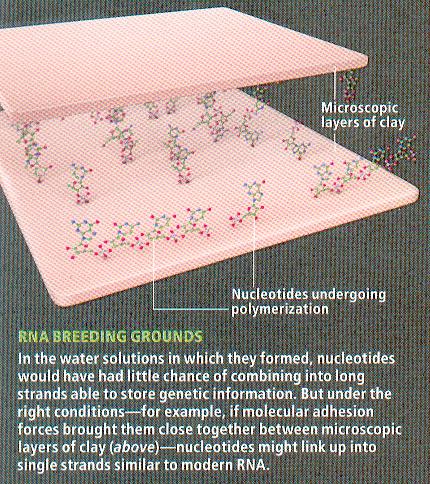
We have seen that the “Little Warm Pool Model” suggested that the earliest amino acids and nucleotides formed in water solutions. But a minority school of scientists argues that these monomers, free-floating in water, would have had little chance of combining into the long polymer strands of proteins, RNA, and DNA, respectively.
The “Silicate Crystals” or “Clay Surfaces” model proposes that complex organic molecules evolved gradually by utilizing silicate crystal surfaces as a template or scaffold. This theory posits that early, simple organic molecules would adhere to adjacent layers of a silicate crystal substrate. There, they could join up with others to make longer polymer molecules. In other words, the organic cells may have used the inorganic clay-crystals as a scaffolding or substrate on which to build their “working molecules” – the peptides, proteins, and nucleotides. Or perhaps the crystal surfaces served as templates for linking chains of peptides and forming the first cell membranes or walls. (See https://sites.google.com/site/originsoflifecarlmont/clay-theory.)
Conceivably, such silicate clays could have acted as tiny “chemical factories” for processing organic materials into the more complex molecules from which the first life arose. (See https://sites.google.com/site/originsoflifecarlmont/clay-theory.)
Going further, it is suggestive that silicate-clay crystals can replicate by splitting apart, with one “mother” crystal giving rise to one or more “daughter” crystals. Each crystal can even have its own peculiarities, which it can pass on to its daughter crystals – much like the way living things inherit traits from their parents. And sometimes, when a crystal breaks apart, new quirks can be introduced, for instance, because of the stress of breaking. This is similar to the processes of reproduction and genetic mutation, which create new traits in living things. 10
If the “Clay Surfaces” Model holds true, clay mineral crystals were a link between the worlds of inorganic evolution and biological evolution. (See Leslie March, “Life’s Crystal Code,” 3-19-2009, www.space.com.
An individual silicate crystal in a clay suspension naturally forms and extends itself by attaching “loose” atoms from the watery clay around it, similar to the way that a snowflake forms and grows in a cloud consisting of cold-water vapor. Generally, once a crystal formation starts to take on a shape, it continues to grow along that same pattern. 11 When these crystals are held in a watery suspension, they take on the plasticity characteristic of clay.
> The Earliest Silicate-Clay Model
In 1949, the Irish scientist J.D. Bernal suggested that clay minerals may have provided a meeting place for the first molecules of life. 12 In the mid-1960s, organic chemist Alexander Cairns-Smith published a controversial book, Seven Clues to the Origin of Life, laying out his hypothesis that self-replication of clay crystals in solution might have provided a simple intermediate step between biologically inert matter and organic life.
The Cairns-Smith theory also contended that when silicate clays dry out, flakes of them can be blown about by the wind. If they land somewhere where they again become wet, the pre-organic molecules within them could resume their processes in a new location. In this way, pre-life could have spread around large areas of land. (See the website, https://sites.google.com/site/originsoflifecarlmont/clay-theory.)
Through the next four decades, however, diverse laboratory investigations of silicate clays mediating peptide bond formation had only limited success. The peptide molecules that formed in the laboratory were “over-protected” in the laboratory environment, and thus showed no evidence of inheritance or metabolism.
> Recent Research on Silicate-Clays – Creating Peptides & Nucleotides
A 2009 study at Rensselaer Polytechnic Institute in Troy, New York, did show that current-day RNA could have formed on the surface of clays, which act as catalysts to bring RNA together. 13
In December 2017, a revised theoretical model developed by Erastova and his collaborators suggested that peptides could form at the interlayers of layered clays such as the so-called “green rust” in early Earth conditions. According to this model, drying of the layered material should provide the energy and co-alignment required for peptide bond formation. Then, a re-wetting should allow mobilization of the newly formed peptides and the repopulation of the interlayer with new amino acids. This mechanism would lead to the formation of peptides that are over 12 amino acids long after 15 to 20 consecutive washes. 14
> Silicate-Clay Layers May Have Templated the Genetic Code in DNA
Cairns-Smith’s theory went much further than the formation of peptides and nucleotides on a silicate crystal surface. He also proposed that a DNA molecule might have arisen as a cross-section down through a set of crystal layers: “In that respect,” the layers are “like a DNA molecule, which has base pairs platelets stacked on top of each other. It is the sequence of this stacking which creates the information.” 15
Rebecca Schulman, a bioengineer at Johns Hopkins University in Baltimore, Maryland, designed a laboratory system that encodes information in a crystal structure. Rather than using naturally occurring minerals, Schulman used crystals composed of nanometer-scale tiles made of DNA. Dr. Schulman found, first through computer simulation and then by experiment, that the DNA tiles could stack up in a particular pattern, effectively encoding information in a crystal structure. She had found a way to represent and copy information in crystal form. 16.
> The “Diamond Variation” of the Silicate Clays Model
Andrei Sommer of the University of Ulm in Germany proposes that a specific type of crystal – the “hydrogenated diamond” – may have been the crystal that was most able to host the Origin of Life on its surface. It is totally non-toxic and completely biocompatible,” he says. “Hydrogenated diamonds” have gained a rigid outer coating of hydrogen atoms from local gas-emitting volcanoes during Earth’s volcanic age. When a hydrogenated diamond is wetted, the water molecules line up on the surface as if they were frozen into a crystal layer (an analogy might be static electricity making all the hairs on your head stand up. 17
Surprisingly, these crystal water layers do not disappear when the hydrogenated diamond is fully immersed in water. Because this is the only natural material known to exhibit this behavior, Sommer’s team proposes that small organic molecules in the primordial soup landed on hydrogenated diamonds and were helped by their robust crystal water layers into linking together to form proteins and DNA. 18
Support for this idea comes from a recent study that found that certain nucleobases (the building blocks of DNA and RNA) form an organized pattern on the surface of graphite, which is chemically similar to diamond. 19
> Summary Comments on the Silicate-Clays Models
The “Silicate Crystals” or “Clay Surfaces” model holds a minority position today. Most scientists who work on the problem of life’s origin focus instead on how simple sugars, amino acids, and other organic chemicals came together to form nucleic acids and proteins. 20
On the other hand, Professor Robert Hazen says this: “Many of life’s most vital molecular building blocks stick to virtually any natural mineral surface…. [including amino-acids, sugars, and the components of DNA and RNA]… What’s more, when several molecules compete for the same piece of crystal real estate, they often cooperate and yield complex surface structures of their own.” 21
If crystals do provide the order in which Life needs to arise, that has implications for the possibility of life beyond Earth. Mineral crystals should be common on rocky worlds, even if those planets have chemical environments quite different from our own. 22
6. “Deep-Hot Biosphere” Model of First Life
In 1992, the astrophysicist Thomas Gold proposed the theory that life first developed not on the surface of the Earth, but several kilometers below the Earth’s surface and widely distributed across our planet. 23
The discovery in the late 1990s of nanotubes (filament structures that are smaller than bacteria but that may contain DNA found in deep rocks) [33] may support Dr. Gold’s theory. Gold’s theory posited that the main flow of food to these extremophiles came from primordial methane gas rising out of Earth’s interior mantle.
In a paper called “The Deep Hot Biosphere,” Gold wrote that “This model holds that the first living things were single-cell microorganisms that were the ancestors of both bacteria and archaea. Gene sequencing studies can be used to reconstruct the bacterial phylogeny (ancestral trees), and these studies indicate that the most recent common ancestor of bacteria and archaea was probably a hyperthermophile (an organism that thrives in extreme heat) that lived approximately 2.5 billion to 3.2 billion years ago, likely near an underwater volcanic vent or hot spring.
If Gold’s model is correct, the earliest life on land may have been organisms some 3.2 billion years ago. 24
It is also reasonably well established that microbial life is plentiful today, at depths in the Earth up to five kilometers below the surface. Most of them are extremophile (“loving harsh conditions”) archaea, rather than bacteria, which typically live in more temperate zones near and at the surface. Studies reveal a rich subterranean ecosystem that is almost twice the size of all the world’s oceans. Scientists estimate this subterranean biosphere is teeming with micro-organisms totaling hundreds of times the combined weight of every human on the planet. 25
Methanogens (anaerobic microbes that generate methane as a by-product) have been found in several extreme environments on Earth, including hot, dry deserts and buried under kilometers of ice. Microbes making methane were found in a glacial ice core sample retrieved from about three kilometers under Greenland by researchers from the University of California, Berkeley. They also found a constant metabolism able to repair macromolecular damage at temperatures ranging from 293 to –40 °Fahrenheit. 26
There is also molecular, microscopic, and metagenomic evidence that (“iron-eating”) cyanobacteria predominate in deep subsurface rock samples from southwestern Spain. Results suggest that cyanobacteria may continue to play an important role as primary food producers within the deep-Earth biosphere. 27
Thermophiles Living around Hot Springs, Geysers, & Fumaroles
A thermophile is an organism—a type of extremophile—that thrives at high temperatures between 106 and 252 °F. Thermophiles are usually microbes, and many are archaea. Thermophiles are found in the decaying plant matter of peat bogs and compost.
Hyperthermophiles are inhabitants of hot, sulfur-rich environments usually associated with volcanism, such as the hot springs, geysers, and fumaroles of Yellowstone Park. Hyperthermophiles isolated from hot springs in Yellowstone National Park were first reported by Thomas D. Brock in 1965. Since then, more than 70 species have been established. Many of the hyperthermophilic archaea require elemental sulfur for growth, including anaerobes that use sulfur instead of oxygen as an electron acceptor during cellular respiration.
Research has shown that some minerals can catalyze the stepwise formation of hydrocarbon tails of fatty acids from hydrogen and carbon monoxide gases—gases that may have been released from hydrothermal vents or geysers. Since vesicle (lipid sphere) formation requires a higher concentration of fatty acids, some scientists suggest that protocell formation started at land-bound hydrothermal vents such as geysers, mud pots, and fumaroles, where water evaporates and concentrates the solution. 28
Thermophiles and hyperthermophiles demonstrate how hardy life can be, and they imply that life can arise on other planets that are not in Earth’s so-called “Goldilocks Zone” of moderate temperatures and pressures. (For more, see the Wikipedia article, Extremophile.)
7. The Deep-Sea Model of First Life on Earth

A deep-sea “Black Smoker”
Hydrothermal Vent
“Black Smokers”
We’ve stated that organisms capable of chemosynthesis can utilize inorganic electron donor sources, including hydrogen sulfide, elemental sulfur, ferrous iron, molecular hydrogen, ammonia, and organic compounds.
Today, many thermophile and hyperthermophile microbes flourish in and around the hot volcanic vents at the bottoms of our deepest oceans, where Earth’s tectonic plates meet. They form large microbial communities surrounding these undersea vents, making them the primary food source for an entire food chain of more complex multicellular creatures, including shrimp and giant tube worms that can be up to 6 feet tall. Many scientists hold that life began in and around these deep-sea hydrothermal vents.
“Black Smokers,” formally known as Hydrothermal Vents, were first discovered in 1979 on the East Pacific Rise, the main tectonic plate boundary that runs down the middle of the South Pacific Ocean and then curves west almost to the tip of India. 29
The most extreme thermophiles, hyperthermophiles, live on the superheated walls of deep-sea hydrothermal vents, requiring temperatures of at least 194°Fahrenheit for survival. An extraordinary heat-tolerant hyperthermophile, “Strain-121,” has been able to double its population during 24 hours in an autoclave at 121 °C (hence its name). 30
The deep-sea organisms discovered around these vents have no access to sunlight and therefore cannot engage in photosynthesis. Instead, the diverse ecological communities surrounding these vents depend on nutrients found in the dusty chemical deposits and hydrothermal fluids thrown up by the undersea vents. Compared to the surrounding sea floor, however, these communities have a density of organisms 10,000 to 100,000 times greater than the surrounding ocean floor.
Biological Communities Around Deep-sea Vents
The chemotrophic bacteria around the deep-sea vents form a thick mat that attracts other organisms, such as shrimp-like amphipods and copepods, which graze on the bacteria. Larger organisms, such as snails, clams, limpets, shrimp, crabs, tube worms, sea snails, slugs, fish (especially eelpout and cutthroat eel), and octopuses, form a food chain of predator and prey relationships above the primary consumers.

Giant Tube Worms Around Hydrothermal Vents
Giant Tube Worms, which may grow to over 6.6 ft tall in the largest species, often form an important part of the community around a hydrothermal vent. The tube worms have no mouth or digestive tract and, like parasitic worms, they absorb nutrients produced by the bacteria in their tissues. About 285 billion bacteria are found per ounce of tubeworm tissue. Tubeworms have red plumes that contain hemoglobin. Hemoglobin combines with hydrogen sulfide and transfers it to the bacteria living inside the worm. In return, the bacteria nourish the worm with carbon compounds. 31
Over 300 new species, including microbes and multicellular animals, have been discovered at hydrothermal vents, including more than 100 gastropod species (sea snails and slugs). 32
The ecological communities around deep-sea vents can sustain such vast amounts of life because, at the bottom of the communal food chain, are large populations of chemotrophic bacteria that consume water from the hydrothermal vents, which are rich in dissolved minerals. A large population of bacteria consumes the sulfur compounds in the water, particularly hydrogen sulfide (a chemical highly toxic to most known organisms), and employs chemosynthesis to produce abundant organic material.
Undersea hydrothermal vents are now often found near volcanically active areas, including those where tectonic plates are moving apart at spreading centers, ocean basins, and hotspots. Black smokers (as well as related white smokers) are now known to exist in the Atlantic and Pacific Oceans, at an average depth of 2100 meters. The most northerly black smokers are a cluster of five named Loki’s Castle, discovered in 2008 on the Mid-Atlantic Ridge between Greenland and Norway. 33
Active hydrothermal vents are also thought to exist on Jupiter’s moon Europa and Saturn’s moon Enceladus, and it is speculated that ancient hydrothermal vents once existed on Mars. 34
How About “Thermo-synthesis?”
Biology has instances of Chemosynthesis and Photosynthesis. Did the microorganisms growing around undersea hydrothermal vents ever use thermosynthesis, i.e., the heat from those vents, to drive their constructive metabolism? While there is little concrete evidence of this, Professor Anthony Muller at the University of Amsterdam has proposed a theoretical mechanism (a model) by which this could have taken place. The components of the biological thermosynthesis machinery would be related to today’s process of ATP synthesis. It also resembles the process by which organic molecules adhere to the surfaces of clay crystals.
Muller proposes that this simple type of energy conversion may have sustained the origin of life, including the emergence of the RNA World. Thermosynthesis also permits, theoretically, a simple model for the origin of photosynthesis. However, no organisms are known at present that use thermosynthesis as a source of energy. 35
Deep-Sea “Iron-Eaters” and “White Smokers.”
 Photo of “White Smoker” thermal vents at “The Lost City Hydrothermal Field” on the Atlantic Ocean floor.
In the deep oceans, there are also iron-oxidizing bacteria (cyanobacteria) that derive their energy needs by oxidizing ferrous iron (Fe2+) to ferric iron (Fe3+). (See Wikipedia entry on “Lost City Hydrothermal Field,” where the carbonate thermal vents come out of mineral structures known as “The White Smokers.” Biochemist Nick Lane and geologist Michael John Russell argue that First Life probably originated from progenitors of the White Smokers, because the chemistry there is more compelling than that around the Black Smokers. Dr. Lane has filmed a number of illustrated lectures on chemistry around The Origin of Life, all of which can be viewed on YouTube.
8. The Panspermia Model of First Life
The discovery of undersea chemosynthesis revealed that terrestrial life, life on planet Earth, does not require sun dependence; it only needs water and an energy gradient to exist. [wiki on panspermia]
In addition, the discovery of deep-sea ecosystems, along with advancements in the fields of astrobiology, observational astronomy, and the identification of a wide variety of extremophiles, has opened up a new avenue in astrobiology by massively expanding the number of possible extraterrestrial habitats and the potential for the transport of hardy microbial life over vast distances. 36
Note: The section below this Essay is paraphrased from the Wikipedia article Panspermia, as it appeared in February 2021. The footnotes citing that article’s sources are included at the end of this Essay.
“The chemistry leading to life may have begun shortly after the Big Bang, 13.8 billion years ago, during a habitable epoch when the Universe was only 10 to 17 million years old. Though the presence of life has been confirmed only on Earth, some scientists think that extraterrestrial life is not only plausible but probable or inevitable. 37
“From the early 1970s, it started to become evident that interstellar dust included a large component of organic molecules. Interstellar molecules are formed by chemical reactions within sparse interstellar or circumstellar clouds of dust and gas. The dust plays a critical role in shielding the molecules from the ionizing effect of ultraviolet radiation emitted by stars. 38
“The Panspermia Model of First Life is the hypothesis that life exists throughout the Universe, distributed by space dust, meteoroids, asteroids, comets, and planetoids. Distribution may have occurred spanning galaxies, and so may not be restricted to the limited scale of solar systems. 41
Latest Evidence of Proto-life (Pre-Life) from Beyond Earth
A 2017 paper from McMaster University in Canada and the Max Planck Institute in Germany showed that the building blocks of RNA could have polymerized in the early Earth using organic molecules from meteorites and interplanetary dust in shallow ponds. The wet/dry cycle of these ponds, they showed, was conducive to RNA polymerization. 42
In January 2018, a study (See https://en.wikipedia.org/wiki/Earliest_known_life_forms) found that 4.5 billion-year-old meteorites found on Earth contained liquid water along with prebiotic complex organic substances that may be ingredients for life. 43
In 2023, a return capsule from the 2016 rocket probe OSIRIS-REx landed on Earth. It carried samples of dust from an asteroid named “Bennu.” This dust contains 16,000 kinds of organic molecules, among them the 16 amino acids our cells use to make proteins. The dust also contains all four of the large nucleobases that compose our DNA. The journal NATURE reports that scientists think a larger “Parent” asteroid formed in the outer solar system, beyond the orbit of Jupiter. Far from the sun’s heat, the parent asteroid was likely kept warm by interior radioactivity, allowing organic molecules to form in warm pools or undersea vents. At some point, Bennu’s parent asteroid was blasted into an orbit between Mars and Earth. There, it was smashed into bits by a later collision. One of those bits is the ball of dust called Bennu. Scientists at universities concur that this discovery strongly implies that the molecular processes leading to Life happened at locations other than planet Earth. (See, “Lurking Inside an Asteroid: Life’s Ingredients,” reported by Carl Zimmer for The New York Times, 1-31-2025.)
“Although computer models suggest that a captured meteoroid would typically take some tens of millions of years before collision with a planet, there are documented viable Earthly bacterial spores that are 40 million years old that are resistant to radiation, and others able to resume life after being dormant for 100 million years, suggesting that lithopanspermia life-transfers are possible via meteorites exceeding 1 m in size. 46
“In January 2025, it was reported that a wide range of carbon- and nitrogen-rich organic compounds have been identified in samples returned from Bennu, including 14 of the 20 amino acids that make up proteins in terrestrial organisms, as well as all four nucleobases (adenine, thymine, cytosine, and guanine) that are the essential building blocks of DNA and RNA. The samples contain a nearly equal mix of left-handed (L) and right-handed (D) amino acids, raising possibilities about whether asteroids like Bennu helped shape Earth’s biochemistry.” (Quoted from Wikipedia article, “OSIRIS-REx.”)
Where Life Began: ‘Warm Pools?’ ‘Black Smokers?’
(Essay #15, at 6-23-25)
This is also the fourth of four (#12 to #15) interrelated Essays on Earth’s geochemical origin of life. Here are the titles of those four Essays:
Essay #12 — Chemical Precursors to Life on Earth
Essay #13 — The Organic Molecules & Processes that Form Life
Essay #14 — Abiogenesis: Evolution of the First Life on Earth
Essay #15 — Where Life Began: Warm Pools? Black Smokers? (the Essay you are reading now)
An earlier Essay, “The Processes of Evolution & Their Meaning,” is just as important as the “biological four” Essays listed above because it describes the evolution happening all around us, here and now, in three arenas: biology, culture, & technology. It takes all five Essays to fully explain how the processes of evolution provide us with our complete human sense of, and appreciation for, Evolution’s connectedness & meaning based on Nature, Science, & History.
Note: Some readers may have elected to skip sections of our Essays #12 and #13, which were technical in several areas. However, like Essay #14, Essay #15 recounts lively stories of dramatic Life Creation in perilous locations.
So far, we’ve only discussed evolutionary paths that were likely to have been followed in creating the precursors for life, e.g., the Four Key Molecules. But gathering those precursors together does not necessarily mean that they will all function together to do enclosure, respiration, metabolism, and replication. Protocells might only do three of the four, or protocells might perform all four, in primitive ways. In other words, the earliest protocells may have been more akin to chemical systems than living systems. 47
How did we get just the correct sequences of physics, geology, and chemistry to produce a functional “First Organism?” What sort of general (and local) environment was required? What materials were needed to be on hand? What kind of energy supply? What temperature and what pressure?
There is not much evidence about how Life got from amino acids free-floating in water to the first single-celled, membrane-enclosed proto-bacteria (or proto-archaea), but there are several models (hypotheses) describing where and how First Life was “put together.” Each model has significant support in the scientific community.
One thing all the models will show us is that early life was highly adaptable. Life is a strong seeker, a powerful explorer. Life finds a way! Not always, but often, and if not often, often enough! This remarkable adaptability has resulted in an incredible diversity of single-celled life forms and portends an even greater abundance of diversity in the realms of multicellular plant and animal life, as we shall see in our (as yet unwritten) Essay.
“Extremophiles”- Microbes Living in Harsh Environments
Before we look at the eight models of Where Life Began, consider where present-day archaea and bacteria are now living. Since they are the simplest organisms we have today, perhaps First Life originated in one (or more) of these environments.
What we find is that modern microbes live in virtually all of Earth’s environments today. And since “all” of our environments include some extremely harsh ones, we need to examine those, primarily since life most likely originated in the early Archaean Eon, when Earth’s intense volcanic activity produced tremendous heat and subterranean pressure.
In fact, most chemotrophs (including the ones we discussed earlier that consume inorganic elements like sulfur and iron) are “extremophiles” — bacteria and archaea that live in hostile environments, including those deep in the Earth and deep in its oceans.
Since early Earth was much more inhospitable than it is today, this suggests that the first archaea and/or the first protocells were also extremophiles. Examples of these Archean Eon extremophiles are as follows:
- Thermophiles – heat-loving.
- Psychrophiles – cold-loving.
- Alkaliphiles – loving alkaline conditions.
- Acidophiles — loving acidic conditions
- Piezophiles, — loving high pressure (in the deep oceans or deep Earth).
- Halophiles – loving high-salt concentrations.
- Thermoacidophiles – loving both heat and acid. (These are archaea that live around acidic hot springs and in dumps of acidic mining waste.)
It is now known that extremophiles (microorganisms with extraordinary capability to live in the harshest environments on Earth) can specialize to thrive in the deep-sea, ice, boiling water, acid, the water core of nuclear reactors, salt crystals, toxic waste, and in a range of other extreme habitats that were previously thought to be inhospitable for life. 48
Living bacteria found in ice core samples retrieved from 3,700 meters (12,100 ft.) deep at Lake Vostok in Antarctica have provided data for extrapolations to the likelihood of microorganisms surviving frozen in extraterrestrial habitats or during interplanetary transport. Also, bacteria have been discovered living within warm rock deep in the Earth’s crust. In the laboratory, Metallosphaera sedula bacteria have been grown on meteorites. 49
This variety of acceptable habitats is a good segue to our next section, which discusses the various places on Earth where The Origin of Life may have occurred.
The 8 Models of How & Where First Life Came Together
Today, in the year 2024, there are eight models of where, when, and how First Life got its start. As models, or “theories,” each of these has both scientific support and scientific objections.
1. The Little Warm Pool Model
2. The Hollow Lipid Spheres or “Protocell” Model (often seen as a corollary to the warm pool model)
3. The Iron-Sulfide Cavities or “Tiny Pockets in Rocks” Model
4. The Clay Hydrogel Model
5. The Silicate-Clay, Crystal-surface-templates Model (the “Cairns-Smith” Clay Model)
6. The Deep-hot Biosphere Model
7. The Deep-Sea Model (could be a corollary to the Deep-Hot model)
8. The Panspermia Model
We will examine each of these models in turn. The numbers on this list are provided for reference only; there is no established chronology or order of importance. Currently, science lacks a consensus on which of these eight models is the most probable.
There could well have been some combination of two or more of the models. For example, The Warm Little Pool Model (#1) and The Hollow Lipid Spheres Model (#2) may have been two stages of a single model. It is also possible that different models were followed in other geographic locations on Earth.
The Deep-Hot Biosphere Model (#6) could have taken place before one or more of the others, and The Deep-Sea Model (#7) may be an extension or a variant of The Deep-Hot Biosphere Model (#6). Panspermia, Model #8, could have preceded all the others. Each of the models supposedly results in one single protocell. In short, perhaps the eight models ought to be called partial models.
Notice that the important “RNA-World Model” is not on this list. That’s because RNA-World is not really about a particular environment on Earth where life most likely started, nor is it about where and how First Life got its molecular food. RNA World could have happened in any one of the above location-and-food-source models; although it is most often associated with the “Silicate-Clay, Crystal-surface-templates Model,” because, as we shall see, that model provides “templating.”
Whatever the order, the variety of these eight models, all of which have evidence backing them up, testifies to Life’s power to “find a way.”
As Dr. Ian Malcolm, a character in the film Jurassic Park, says: “If there’s one thing the history of evolution has taught us, it’s that life will not be contained. Life breaks free, it expands to new territories and crashes through barriers… painfully, maybe even dangerously, but, uh, well, there it is… Life will find a way!” 50
1. The “Little Warm Pond” Model of First Life
Charles Darwin suggested that simple chemicals in small or shallow bodies of water might spontaneously form organic compounds in the presence of energy from heat, light, or electricity from lightning strikes. These organic compounds could then have replicated and evolved to create more complex forms. 51
Darwin’s “Little Warm Pond” Model (or “little warm pool”) remains one of the most suggestive explanations for the origin of life. A classic experiment performed by Harold Urey and Stanley Miller in the 1950s brought the problem of the origin of life, and the “little warm pool,” into the laboratory. 52
The Miller-Urey experiment tried, in part, to simulate Darwin’s small pond of water. But was the original Pond(s) a freshwater pond or a tidal saltwater pool? Was there a body of water that was calm and peaceful anywhere on Earth during the Hadean Eon? Wouldn’t a strike of lightning or volcanic action (both simulated by Miller-Urey) disrupt the calmness of the water? Wouldn’t a pool or a pond be too spacious and therefore unable to bring the 4 monomers of life close enough together to form chains and become polymers?
Although Miller had made some of the most essential compounds of life, his experiment did not explain how they and other building blocks, such as nucleotides, which make up DNA, first came together in an ordered way to form the complex molecules necessary for life.
2. The “Hollow Lipid Spheres” Model of First Life
The “Hollow Lipid Spheres” Model is really a corollary to the Warm Little Pond model. If a little warm pond was too big to bring the earliest organic molecules sufficiently close to each other, or provide insufficient protection from outside chemicals and currents, some scientists contend that Hollow Lipid Spheres would have been able to do those two things because such spheres are often microscopic.
3. The Iron-sulfide Cavities (‘Tiny Pockets in Rocks’) Model of First Life
In a prior Essay, we explained how organic spheres composed of self-assembling lipid (fat) molecules could have been the first membranes that enclosed the chemical reactions of the First Organism.
However, some scientists feel that such a lipid membrane would not have been strong enough to allow the earliest simple molecules (monomers) that were the building blocks of life to come together and start functioning as a “team.”
The Iron-sulfide Cavities Model contends that First Life did not have to form cell membranes (let alone sturdier outer cell walls), because tiny pockets and fissures in iron-sulfide minerals served to confine and protect each cell’s interior cytoplasm.
We know that hot springs on the ocean floor naturally deposit honeycombs made of the mineral iron-sulfide, which are shot through with tiny air pockets a few hundredths of a millimeter across. Drs. William Martin and Michael Russell argue that these pockets are the ideal places for life to get started. 53
The iron-sulfide cavities model is clearly complementary to the Deep-hot and/or deep-ocean models (#6 and #7) discussed below. Taken together, the iron-sulfide, combined with the surrounding heat, may also have accelerated the chemical reactions that join inorganic molecules together into organic ones.
These models also suggest that life could have originated in this manner at numerous locations and could have persisted under various conditions. 54
Many Living cells have cell walls in addition to cell membranes. Cell walls are usually tougher, thicker substances that form just outside the cell membrane. The walls provide additional protection from the outside environment and can also contribute to the cell’s structural strength. Bone tissue includes cells whose walls are partly made of calcium. The cell walls of tree trunks and branches are made tough by cellulose, an organic polymer molecule composed of linked sugar units. Whether cell walls evolved after or along with cell membranes is outside the scope of this Essay.
One could conceptually combine the lipid model and the mineral pocket model, arguing that First Life originated in iron-sulfide pockets and then constructed its own cell walls against the inner walls of these pockets.
4. The “Clay Hydrogel” Model of First Life
Clays are thought to do two things, and we will talk about each of them as separate models for the emergence of First Life:
- They may isolate and protect proto-organic molecular reactions (e.g., allow chaining), and
- They may provide scaffolds and templates for fledgling organic molecules to cling to.
The first of these two models is known as the Clay Hydrogel Model, and the second is referred to as the Silicate-clay Crystal-surface Templates Model. This section of the Essay is about the first of these two models — the “Clay Hydrogel Model.”
Professor Dan Luo of the Kavli Institute for Nanoscale Science at Cornell proposes that in early geological history, clay hydrogel provided a confinement function for biomolecules and biochemical reactions.” 55
Dr. Luo and his team knew that in simulated ancient seawater, clay forms a hydrogel — a mass of microscopic spaces capable of soaking up liquids like the tiny pockets in a sponge. Over billions of years, chemicals confined in those spaces could have carried out the complex reactions that formed proteins, DNA, and eventually all the machinery that enables a living cell to function. Clay hydrogels could have confined and protected those chemical processes until the membrane that surrounds living cells developed.
“To test the idea, Dr. Luo and his team demonstrated protein synthesis in a clay hydrogel in the laboratory. This experiment demonstrated that synthetic hydrogels can serve as a non-living, “cell-free” medium for protein production… The researchers believe that when the spongy material is filled with amino acids, DNA, the right enzymes, and a few bits of cellular machinery, it may be possible to produce the proteins encoded by the DNA, just as might be done in a vat of living cells… As supporting evidence, geological history shows that clay first appeared as silicates leached from rocks just at the time biomolecules began to form into protocells — cell-like structures, but incomplete – and eventually membrane-enclosed cells… The geological events matched nicely with biological events.” (Paraphrased from Bill Steele’s article, “Before Cells, Biochemicals May Have Combined in Clay,” 11-7-2013, Cornell Chronicle.
As we know, other scientists previously suggested that tiny balloons of fat or polymers (lipid spheres) might have served as precursors of cell membranes. However, clay may be a more promising possibility because biomolecules tend to attach to its surface, and theorists have shown that cytoplasm — the interior environment of a cell — behaves much like a hydrogel. In addition, Professor Luo has found that a clay hydrogel better protects its contents from damaging enzymes (called “nucleases”) that might dismantle DNA and other biomolecules.
5. The Silicate Crystals (“Clay Surfaces”) Model of First Life
Clay, like any silicate, is made up of microscopic crystals. Crystals can grow and accumulate out of solutions. Silicate minerals are the most common of Earth’s minerals and include quartz, feldspar, and mica. When common clay is examined under a microscope, it is seen to be composed of tiny silicate mineral crystals. Within each crystal, atoms are arranged in a structure that repeats in a tightly packed, regular pattern.
We’ve already discussed how the hard, geometric surfaces of non-living mineral crystals can form and maintain ordered shapes and can make themselves grow. Order and growth are characteristics of living things, even though crystals are clearly not living! This suggests that crystals may have been inorganic precursors of life. There is evidence that this is so.
We have seen that the “Little Warm Pool Model” suggested that the earliest amino acids and nucleotides formed in water solutions. But a minority school of scientists argues that these monomers, free-floating in water, would have had little chance of combining into the long polymer strands of proteins, RNA, and DNA, respectively.
The “Silicate Crystals” or “Clay Surfaces” model proposes that complex organic molecules evolved gradually by utilizing silicate crystal surfaces as a template or scaffold. This theory posits that early, simple organic molecules would adhere to adjacent layers of a silicate crystal substrate. There, they could join up with others to make longer polymer molecules. In other words, the organic cells may have used the inorganic clay-crystals as a scaffolding or substrate on which to build their “working molecules” – the peptides, proteins, and nucleotides. Or perhaps the crystal surfaces served as templates for linking chains of peptides and forming the first cell membranes or walls. (See https://sites.google.com/site/originsoflifecarlmont/clay-theory.)
Conceivably, such silicate clays could have acted as tiny “chemical factories” for processing organic materials into the more complex molecules from which the first life arose. (See https://sites.google.com/site/originsoflifecarlmont/clay-theory.)
Going further, it is suggestive that silicate-clay crystals can replicate by splitting apart, with one “mother” crystal giving rise to one or more “daughter” crystals. Each crystal can even have its own peculiarities, which it can pass on to its daughter crystals – much like the way living things inherit traits from their parents. And sometimes, when a crystal breaks apart, new quirks can be introduced, for instance, because of the stress of breaking. This is similar to the processes of reproduction and genetic mutation, which create new traits in living things. 56
If the “Clay Surfaces” Model holds true, clay mineral crystals were a link between the worlds of inorganic evolution and biological evolution. (See Leslie March, “Life’s Crystal Code,” 3-19-2009, www.space.com.
An individual silicate crystal in a clay suspension naturally forms and extends itself by attaching “loose” atoms from the watery clay around it, similar to the way that a snowflake forms and grows in a cloud consisting of cold-water vapor. Generally, once a crystal formation starts to take on a shape, it continues to grow along that same pattern. 57 When these crystals are held in a watery suspension, they take on the plasticity characteristic of clay.
> The Earliest Silicate-Clay Model
In 1949, the Irish scientist J.D. Bernal suggested that clay minerals may have provided a meeting place for the first molecules of life. 58 In the mid-1960s, organic chemist Alexander Cairns-Smith published a controversial book, Seven Clues to the Origin of Life, laying out his hypothesis that self-replication of clay crystals in solution might have provided a simple intermediate step between biologically inert matter and organic life.
The Cairns-Smith theory also contended that when silicate clays dry out, flakes of them can be blown about by the wind. If they land somewhere where they again become wet, the pre-organic molecules within them could resume their processes in a new location. In this way, pre-life could have spread around large areas of land. (See the website, https://sites.google.com/site/originsoflifecarlmont/clay-theory.)
Through the next four decades, however, diverse laboratory investigations of silicate clays mediating peptide bond formation had only limited success. The peptide molecules that formed in the laboratory were “over-protected” in the laboratory environment, and thus showed no evidence of inheritance or metabolism.
> Recent Research on Silicate-Clays – Creating Peptides & Nucleotides
A 2009 study at Rensselaer Polytechnic Institute in Troy, New York, did show that current-day RNA could have formed on the surface of clays, which act as catalysts to bring RNA together. 59
In December 2017, a revised theoretical model developed by Erastova and his collaborators suggested that peptides could form at the interlayers of layered clays such as the so-called “green rust” in early Earth conditions. According to this model, drying of the layered material should provide the energy and co-alignment required for peptide bond formation. Then, a re-wetting should allow mobilization of the newly formed peptides and the repopulation of the interlayer with new amino acids. This mechanism would lead to the formation of peptides that are over 12 amino acids long after 15 to 20 consecutive washes. 60
> Silicate-Clay Layers May Have Templated the Genetic Code in DNA
Cairns-Smith’s theory went much further than the formation of peptides and nucleotides on a silicate crystal surface. He also proposed that a DNA molecule might have arisen as a cross-section down through a set of crystal layers: “In that respect,” the layers are “like a DNA molecule, which has base pairs platelets stacked on top of each other. It is the sequence of this stacking which creates the information.” 61
Rebecca Schulman, a bioengineer at Johns Hopkins University in Baltimore, Maryland, designed a laboratory system that encodes information in a crystal structure. Rather than using naturally occurring minerals, Schulman used crystals composed of nanometer-scale tiles made of DNA. Dr. Schulman found, first through computer simulation and then by experiment, that the DNA tiles could stack up in a particular pattern, effectively encoding information in a crystal structure. She had found a way to represent and copy information in crystal form. 62.
> The “Diamond Variation” of the Silicate Clays Model
Andrei Sommer of the University of Ulm in Germany proposes that a specific type of crystal – the “hydrogenated diamond” – may have been the crystal that was most able to host the Origin of Life on its surface. It is totally non-toxic and completely biocompatible,” he says. “Hydrogenated diamonds” have gained a rigid outer coating of hydrogen atoms from local gas-emitting volcanoes during Earth’s volcanic age. When a hydrogenated diamond is wetted, the water molecules line up on the surface as if they were frozen into a crystal layer (an analogy might be static electricity making all the hairs on your head stand up. 63
Surprisingly, these crystal water layers do not disappear when the hydrogenated diamond is fully immersed in water. Because this is the only natural material known to exhibit this behavior, Sommer’s team proposes that small organic molecules in the primordial soup landed on hydrogenated diamonds and were helped by their robust crystal water layers into linking together to form proteins and DNA. 64
Support for this idea comes from a recent study that found that certain nucleobases (the building blocks of DNA and RNA) form an organized pattern on the surface of graphite, which is chemically similar to diamond. 65
> Summary Comments on the Silicate-Clays Models
The “Silicate Crystals” or “Clay Surfaces” model holds a minority position today. Most scientists who work on the problem of life’s origin focus instead on how simple sugars, amino acids, and other organic chemicals came together to form nucleic acids and proteins. 66
On the other hand, Professor Robert Hazen says this: “Many of life’s most vital molecular building blocks stick to virtually any natural mineral surface…. [including amino-acids, sugars, and the components of DNA and RNA]… What’s more, when several molecules compete for the same piece of crystal real estate, they often cooperate and yield complex surface structures of their own.” 67
If crystals do provide the order in which Life needs to arise, that has implications for the possibility of life beyond Earth. Mineral crystals should be common on rocky worlds, even if those planets have chemical environments quite different from our own. 68
6. “Deep-Hot Biosphere” Model of First Life
In 1992, the astrophysicist Thomas Gold proposed the theory that life first developed not on the surface of the Earth, but several kilometers below the Earth’s surface and widely distributed across our planet. 69
The discovery in the late 1990s of nanotubes (filament structures that are smaller than bacteria but that may contain DNA found in deep rocks) [33] may support Dr. Gold’s theory. Gold’s theory posited that the main flow of food to these extremophiles came from primordial methane gas rising out of Earth’s interior mantle.
In a paper called “The Deep Hot Biosphere,” Gold wrote that “This model holds that the first living things were single-cell microorganisms that were the ancestors of both bacteria and archaea. Gene sequencing studies can be used to reconstruct the bacterial phylogeny (ancestral trees), and these studies indicate that the most recent common ancestor of bacteria and archaea was probably a hyperthermophile (an organism that thrives in extreme heat) that lived approximately 2.5 billion to 3.2 billion years ago, likely near an underwater volcanic vent or hot spring.
If Gold’s model is correct, the earliest life on land may have been organisms some 3.2 billion years ago. 70
It is also reasonably well established that microbial life is plentiful today, at depths in the Earth up to five kilometers below the surface. Most of them are extremophile (“loving harsh conditions”) archaea, rather than bacteria, which typically live in more temperate zones near and at the surface. Studies reveal a rich subterranean ecosystem that is almost twice the size of all the world’s oceans. Scientists estimate this subterranean biosphere is teeming with micro-organisms totaling hundreds of times the combined weight of every human on the planet. 71
Methanogens (anaerobic microbes that generate methane as a by-product) have been found in several extreme environments on Earth, including hot, dry deserts and buried under kilometers of ice. Microbes making methane were found in a glacial ice core sample retrieved from about three kilometers under Greenland by researchers from the University of California, Berkeley. They also found a constant metabolism able to repair macromolecular damage at temperatures ranging from 293 to –40 °Fahrenheit. 72
There is also molecular, microscopic, and metagenomic evidence that (“iron-eating”) cyanobacteria predominate in deep subsurface rock samples from southwestern Spain. Results suggest that cyanobacteria may continue to play an important role as primary food producers within the deep-Earth biosphere. 73
Thermophiles Living around Hot Springs, Geysers, & Fumaroles
A thermophile is an organism—a type of extremophile—that thrives at high temperatures between 106 and 252 °F. Thermophiles are usually microbes, and many are archaea. Thermophiles are found in the decaying plant matter of peat bogs and compost.
Hyperthermophiles are inhabitants of hot, sulfur-rich environments usually associated with volcanism, such as the hot springs, geysers, and fumaroles of Yellowstone Park. Hyperthermophiles isolated from hot springs in Yellowstone National Park were first reported by Thomas D. Brock in 1965. Since then, more than 70 species have been established. Many of the hyperthermophilic archaea require elemental sulfur for growth, including anaerobes that use sulfur instead of oxygen as an electron acceptor during cellular respiration.
Research has shown that some minerals can catalyze the stepwise formation of hydrocarbon tails of fatty acids from hydrogen and carbon monoxide gases—gases that may have been released from hydrothermal vents or geysers. Since vesicle (lipid sphere) formation requires a higher concentration of fatty acids, some scientists suggest that protocell formation started at land-bound hydrothermal vents such as geysers, mud pots, and fumaroles, where water evaporates and concentrates the solution. 74
Thermophiles and hyperthermophiles demonstrate how hardy life can be, and they imply that life can arise on other planets that are not in Earth’s so-called “Goldilocks Zone” of moderate temperatures and pressures. (For more, see the Wikipedia article, Extremophile.)
7. The Deep-Sea Model of First Life on Earth
A deep-sea “Black Smoker”
Hydrothermal Vent
“Black Smokers”
We’ve stated that organisms capable of chemosynthesis can utilize inorganic electron donor sources, including hydrogen sulfide, elemental sulfur, ferrous iron, molecular hydrogen, ammonia, and organic compounds.
Today, many thermophile and hyperthermophile microbes flourish in and around the hot volcanic vents at the bottoms of our deepest oceans, where Earth’s tectonic plates meet. They form large microbial communities surrounding these undersea vents, making them the primary food source for an entire food chain of more complex multicellular creatures, including shrimp and giant tube worms that can be up to 6 feet tall. Many scientists hold that life began in and around these deep-sea hydrothermal vents.
“Black Smokers,” formally known as Hydrothermal Vents, were first discovered in 1979 on the East Pacific Rise, the main tectonic plate boundary that runs down the middle of the South Pacific Ocean and then curves west almost to the tip of India. 75
The most extreme thermophiles, hyperthermophiles, live on the superheated walls of deep-sea hydrothermal vents, requiring temperatures of at least 194°Fahrenheit for survival. An extraordinary heat-tolerant hyperthermophile, “Strain-121,” has been able to double its population during 24 hours in an autoclave at 121 °C (hence its name). 76
The deep-sea organisms discovered around these vents have no access to sunlight and therefore cannot engage in photosynthesis. Instead, the diverse ecological communities surrounding these vents depend on nutrients found in the dusty chemical deposits and hydrothermal fluids thrown up by the undersea vents. Compared to the surrounding sea floor, however, these communities have a density of organisms 10,000 to 100,000 times greater than the surrounding ocean floor.
Biological Communities Around Deep-sea Vents
The chemotrophic bacteria around the deep-sea vents form a thick mat that attracts other organisms, such as shrimp-like amphipods and copepods, which graze on the bacteria. Larger organisms, such as snails, clams, limpets, shrimp, crabs, tube worms, sea snails, slugs, fish (especially eelpout and cutthroat eel), and octopuses, form a food chain of predator and prey relationships above the primary consumers.
Giant Tube Worms Around Hydrothermal Vents
Giant Tube Worms, which may grow to over 6.6 ft tall in the largest species, often form an important part of the community around a hydrothermal vent. The tube worms have no mouth or digestive tract and, like parasitic worms, they absorb nutrients produced by the bacteria in their tissues. About 285 billion bacteria are found per ounce of tubeworm tissue. Tubeworms have red plumes that contain hemoglobin. Hemoglobin combines with hydrogen sulfide and transfers it to the bacteria living inside the worm. In return, the bacteria nourish the worm with carbon compounds. 77
Over 300 new species, including microbes and multicellular animals, have been discovered at hydrothermal vents, including more than 100 gastropod species (sea snails and slugs). 78
The ecological communities around deep-sea vents can sustain such vast amounts of life because, at the bottom of the communal food chain, are large populations of chemotrophic bacteria that consume water from the hydrothermal vents, which are rich in dissolved minerals. A large population of bacteria consumes the sulfur compounds in the water, particularly hydrogen sulfide (a chemical highly toxic to most known organisms), and employs chemosynthesis to produce abundant organic material.
Undersea hydrothermal vents are now often found near volcanically active areas, including those where tectonic plates are moving apart at spreading centers, ocean basins, and hotspots. Black smokers (as well as related white smokers) are now known to exist in the Atlantic and Pacific Oceans, at an average depth of 2100 meters. The most northerly black smokers are a cluster of five named Loki’s Castle, discovered in 2008 on the Mid-Atlantic Ridge between Greenland and Norway. 79
Active hydrothermal vents are also thought to exist on Jupiter’s moon Europa and Saturn’s moon Enceladus, and it is speculated that ancient hydrothermal vents once existed on Mars. 80
How About “Thermo-synthesis?”
Biology has instances of Chemosynthesis and Photosynthesis. Did the microorganisms growing around undersea hydrothermal vents ever use thermosynthesis, i.e., the heat from those vents, to drive their constructive metabolism? While there is little concrete evidence of this, Professor Anthony Muller at the University of Amsterdam has proposed a theoretical mechanism (a model) by which this could have taken place. The components of the biological thermosynthesis machinery would be related to today’s process of ATP synthesis. It also resembles the process by which organic molecules adhere to the surfaces of clay crystals.
Muller proposes that this simple type of energy conversion may have sustained the origin of life, including the emergence of the RNA World. Thermosynthesis also permits, theoretically, a simple model for the origin of photosynthesis. However, no organisms are known at present that use thermosynthesis as a source of energy. 81
Deep-Sea “Iron-Eaters” and “White Smokers.”
Photo of “White Smoker” thermal vents at “The Lost City Hydrothermal Field” on the Atlantic Ocean floor.
In the deep oceans, there are also iron-oxidizing bacteria (cyanobacteria) that derive their energy needs by oxidizing ferrous iron (Fe2+) to ferric iron (Fe3+). (See Wikipedia entry on “Lost City Hydrothermal Field,” where the carbonate thermal vents come out of mineral structures known as “The White Smokers.” Biochemist Nick Lane and geologist Michael John Russell argue that First Life probably originated from progenitors of the White Smokers, because the chemistry there is more compelling than that around the Black Smokers. Dr. Lane has filmed a number of illustrated lectures on chemistry around The Origin of Life, all of which can be viewed on YouTube.
8. The Panspermia Model of First Life
The discovery of undersea chemosynthesis revealed that terrestrial life, life on planet Earth, does not require sun dependence; it only needs water and an energy gradient to exist. [wiki on panspermia]
In addition, the discovery of deep-sea ecosystems, along with advancements in the fields of astrobiology, observational astronomy, and the identification of a wide variety of extremophiles, has opened up a new avenue in astrobiology by massively expanding the number of possible extraterrestrial habitats and the potential for the transport of hardy microbial life over vast distances. 82
Note: The section below this Essay is paraphrased from the Wikipedia article Panspermia, as it appeared in February 2021. The footnotes citing that article’s sources are included at the end of this Essay.
“The chemistry leading to life may have begun shortly after the Big Bang, 13.8 billion years ago, during a habitable epoch when the Universe was only 10 to 17 million years old. Though the presence of life has been confirmed only on Earth, some scientists think that extraterrestrial life is not only plausible but probable or inevitable. 83
“From the early 1970s, it started to become evident that interstellar dust included a large component of organic molecules. Interstellar molecules are formed by chemical reactions within sparse interstellar or circumstellar clouds of dust and gas. The dust plays a critical role in shielding the molecules from the ionizing effect of ultraviolet radiation emitted by stars. 84
“The Panspermia Model of First Life is the hypothesis that life exists throughout the Universe, distributed by space dust, meteoroids, asteroids, comets, and planetoids. Distribution may have occurred spanning galaxies, and so may not be restricted to the limited scale of solar systems. 89
“Comets and other icy outer-solar-system bodies are thought to contain large amounts of complex carbon compounds (such as tholins) formed by these processes, darkening the surfaces of these bodies. We know the early Earth was bombarded heavily by comets, possibly providing a large supply of complex organic molecules along with the water and other volatiles the comets contributed.” 90
Latest Evidence of Proto-life (Pre-Life) from Beyond Earth
A 2017 paper from McMaster University in Canada and the Max Planck Institute in Germany showed that the building blocks of RNA could have polymerized in the early Earth using organic molecules from meteorites and interplanetary dust in shallow ponds. The wet/dry cycle of these ponds, they showed, was conducive to RNA polymerization. 91
In January 2018, a study (See https://en.wikipedia.org/wiki/Earliest_known_life_forms) found that 4.5 billion-year-old meteorites found on Earth contained liquid water along with prebiotic complex organic substances that may be ingredients for life. 92
In 2023, a return capsule from the 2016 rocket probe OSIRIS-REx landed on Earth. It carried samples of dust from an asteroid named “Bennu.” This dust contains 16,000 kinds of organic molecules, among them the 16 amino acids our cells use to make proteins. The dust also contains all four of the large nucleobases that compose our DNA. The journal NATURE reports that scientists think a larger “Parent” asteroid formed in the outer solar system, beyond the orbit of Jupiter. Far from the sun’s heat, the parent asteroid was likely kept warm by interior radioactivity, allowing organic molecules to form in warm pools or undersea vents. At some point, Bennu’s parent asteroid was blasted into an orbit between Mars and Earth. There, it was smashed into bits by a later collision. One of those bits is the ball of dust called Bennu. Scientists at universities concur that this discovery strongly implies that the molecular processes leading to Life happened at locations other than planet Earth. (See, “Lurking Inside an Asteroid: Life’s Ingredients,” reported by Carl Zimmer for The New York Times, 1-31-2025.)
“In January 2025, it was reported that a wide range of carbon- and nitrogen-rich organic compounds have been identified in samples returned from Bennu, including 14 of the 20 amino acids that make up proteins in terrestrial organisms, as well as all four nucleobases (adenine, thymine, cytosine, and guanine) that are the essential building blocks of DNA and RNA. The samples contain a nearly equal mix of left-handed (L) and right-handed (D) amino acids, raising possibilities about whether asteroids like Bennu helped shape Earth’s biochemistry.” (Quoted from Wikipedia article, “OSIRIS-REx.”)
In Our Next Essay, #16, “The Rise of Multicellular Organisms” —
In our next Essay, “The Rise of Multicellular Organisms,” we discuss the significant evolutionary events that occurred relatively soon after the early single-celled archaea and bacteria established a foothold on Earth.
For the first time, we have a fossil record that documents many of the organisms that have evolved. For example, we see a fossil record of large bacterial colonies called “mats,” and we have clear evidence of the silica shells left by the diatoms (a species of single-celled protists).
Here are some of the subjects we cover in The Rise of Multicellular Organisms, Essay #16.
- The formation of colonies, including some very extensive “mats” of microbes and algae floating on the surface waters.
- The engulfment of some microbes by other, larger microbes, with the captured organisms becoming what we now call organelles, including the cell nuclei, mitochondria, and chloroplasts. These enclosures provide the host cell with specialized functions and assume a symbiotic relationship with the host.
- Evolution of Eukaryotes — Cells that have “captured” other cells to do special functions.
- The cyanobacteria almost single-handedly create Earth’s oxygenated atmosphere through photosynthesis
- The slime mold: How a single-celled creature can evolve amazing capabilities
- Networks of transport and communication within colonies.
- Multicellularity is the foundation for the specialization of cells within organisms.
_________________________
— J.X. Mason. ContinuingCreation.org
Endnotes for Essay #15:
- Arvin Ash, “Abiogenesis – How Life Came from Inanimate Matter,” a video film, 9-6-2019, www.arvinash.com
- Wikipedia article on “Panspermia,” particularly footnotes 163 through 169.
- Wikipedia article on “Panspermia,” particularly footnotes 171 through 173.
- Jurassic Park, the 1993 motion picture, Amblin Entertainment, Universal Studios; Dr. Malcolm was played by Jeff Goldblum. The movie follows the 1990 novel of the same name, Jurassic Park, written by Dr. Michael Crichton.
- https://www.encyclopedia.com/science/science-magazines/did-life-earth-begin-little-warm-pond.
- https://www.encyclopedia.com/science/science-magazines/did-life-earth-begin-little-warm-pond.
- W. Martin and M. Russell, “On the Origins of Cells: A Hypothesis for the Evolutionary Transitions from Abiotic Geochemistry to Chemoautotrophic Prokaryotes, and From Prokaryotes to Nucleated Cells,” Philosophical Transactions of the Royal Society, B, published online at Nature.com. doi:10.1098/rstb.2002.1183 (2002). https://www.nature.com/news/2002/021202/full/news021202-2.html.
- John Whitfield, “New Theory for Origin of Life: Mineral Cells Might Have Incubated First Living Things,” Nature, 12-4-2002, doi:10.1038/news021202-2. See also, Roldane, N. Hollinsworth, et al., “Bio-inspired CO2 Conversion by Iron Sulfide Catalysts Under Sustainable Conditions,” Royal Society of Chemistry, 3-24-15. https://pubs.rsc.org/en/content/articlehtml/2015/cc/c5cc02078f.
- D. Luo, D. Yang, S. Peng, and G.Q. Lu, “Enhanced Transcription and Translation in Clay Hydrogel and Implications for Early Life Evolution,” Scientific Reports, 11-7-2013; https://www.nature.com/articles/srep03165.
- Martha Henriques, “The Idea that Life Began as Clay Crystals is 50 Years Old,” 8-24-2016, BBC.
- https://sites.google.com/site/originsoflifecarlmont/clay-theory. See also Martha Henriques, “The Idea that Life Began as Clay Crystals is 50 Years Old,” 8-24-2016, BBC.
- Leslie Mullen, “Life’s Crystal Code,” www.space.com.
- Arvin Ash, “Abiogenesis,” a video film, Ibid.
- V. Erastova, MT Degiacomi, D. Fraser, & HC Greenwell, “Mineral Surface Chemistry Control for Origin of Prebiotic Peptides,” Dec. 2017, Nature Communications. 8 (1): 2033. Bibcode:2017NatCo…8.2033E. doi:10.1038/s41467-017-02248-y. PMC 5725419.
- Leslie Mullen, “Life’s Crystal Code,” www.space.com.
- Martha Henriques, Ibid. See also, “Picture Citations” at http://universe-review.ca/I11-02-clay.jpg
- Michael Schirber, “Diamonds May Be Life’s Birthstone,” Space.com, 9-25-2008, https://www.space.com/5882-diamonds-life-birthstone.html.
- Michael Schirber, Ibid.
- Michael Schirber, Ibid.
- Leslie Mullen, “Life’s Crystal Code,” www.space.com, 3-19-2009.]
- Robert Hazen, Ibid., p.138.
- Leslie Mullen, “Life’s Crystal Code,” www.space.com, 3-19-2009.
- D.R. Colman, S. Poudel, et. al, The Deep, Hot Biosphere: Twenty-five Years of Retrospection,” Proceeding of the National Academy of Science, (PNAS), 7-03-2107, https://www.pnas.org/content/114/27/6895. See also, https://doi.org/10.1073/pnas.1701266114.
- Martin Homann, et al., “Microbial life and Biogeochemical Cycling on Land 3,220 Million Years Ago,” 7-23-2018, Nature Geoscience,11 (9): 665–671. Bibcode:2018NatGe..11..665H. doi:10.1038/s41561-018-0190-9. S2CID 134935568; from the article “Bacteria,” on Wikipedia, https://en.wikipedia.org/wiki/Bacteria.
- Jonathan Watts, “Scientists Identify Vast Underground Ecosystem Containing Billions of Micro-organisms,” The Guardian, 12-10-2018, https://www.theguardian.com/science/2018/dec/10/tread-softly-because-you-tread-on-23bn-tonnes-of-micro-organisms.
- HC Tung, NE Bramall, PB Price, 2005, “Microbial Origin of Excess Methane in Glacial Ice and Implications for Life on Mars,” Proceedings of the National Academy of Sciences, 102 (51): 18292–6. Bibcode:2005PNAS,10218292T. doi:10.1073/pnas.0507601102. PMC 1308353. PMID 16339015.
- F. Puente-Sanchez, A. Arce-Rodrigues, et al., Viable Cyanobacteria in the Deep Continental Subsurface, Proceedings of the National Academy of Sciences, 10-1-2018, https://www.pnas.org/content/115/42/10702. From Wikipedia, “Earliest Known Life Forms.”
- Carl Zimmer, “What Came Before DNA?” Discover Magazine, 6-26-04.
- Sean Chamberlin, “Black Smokers and Giant Worms,” 1999, Fullerton College, Retrieved 2-11-2011. See also, Brent C. Christner, 2002, “Detection, Recovery, Isolation, and Characterization of Bacteria in Glacial Ice and Lake Vostok Accretion Ice,” 2002, Ohio State University.
- Office of Legislative Affairs, “Microbe from Depths Takes Life to Hottest Known Limit,” 8-14-2003, National Science Foundation, https://www.nsf.gov/od/lpa/news/03/pr0384.htm.
- A.V. 22 Sysoev, A. V.; Kantor, Yu. I. (1995). “Two new species of Phymorhynchus (Gastropoda, Conoidea, Conidae) from the hydrothermal vents” (PDF). Ruthenica. 5: 17–26. From the Wikipedia article, “Hydrothermal Vent.”
- “Extremes of Eel City,” Astrobiology Magazine. 28 May 2008. See also, A. V. Sysoev and Y.I. Kantor, (1995). “Two New Species of Phymorhynchus (Gastropoda, Conoidea, Conidae) From the Hydrothermal Vents,” 1995, at Ruthenica. 5: 17–26. See also S. Botos, “Life on a Hydrothermal Vent,” Hydrothermal Vent Communities.
- Live Science Staff, “Boiling Hot Water Found in Frigid Arctic Sea,” LiveScience, https://www.livescience.com/9588-boiling-hot-water-frigid-arctic-sea.html.
- Kenneth Chang, “Conditions for Life Detected on Saturn Moon Enceladus,” 4-13-2017, New York Times. See also, “Spacecraft Data Suggest Saturn Moon’s Ocean May Harbor Hydrothermal Activity,” NASA, 3-11-2015. See also, M. Paine, “Mars Explorers to Benefit from Australian Research,” 5-15-2001, Space.com. Both references are from the Wikipedia article “Hydrothermal Vent.”
- For 19 separate footnote references to Dr. Muller’s scientific papers on this topic, see the Wikipedia article on Thermosynthesis.
- C. Mileikowsky, F.A. Cucinotta, J.W. Wilson, et al., “Natural Transfer of Microbes in Space, Part I: From Mars to Earth and Earth to Mars,” 2000, Icarus, 145 (2): 391–427. Bibcode: 2000Icar.145.. 391 M. doi:10.1006/icar. 1999.6317. PMID 11543506.
- From the Wikipedia article on “Panspermia.”
- A. Dalgarno, A. “The Galactic Cosmic Ray Ionization Rate,” 2006, Proceedings of the National Academy of Sciences. 103 (33): 12269–73. Bibcode:2006PNAS..10312269D. doi:10.1073/pnas.0602117103. PMC 1567869. PMID 16894166. See also, Laurie Brown, Abraham Pais, and A.B. Pippard, “The Physics of the Interstellar Medium,” 1995, Twentieth Century Physics (2nd ed.), p. 1765. ISBN 978-0-7503-0310-1.
- Seth Shostak, “Comets and Asteroids May Be Spreading Life Across the Galaxy – Are Germs From Outer Space the Source of Life on Earth?” 10-26-2018, NBC News. See also, Idan Ginsburg, M. Lingham, and Abraham Loeb, “Galactic Panspermia,” 11-19-2018, The Astrophysical Journal Letters. 868 (1): L12. arXiv:1810.04307v2. Bibcode:2018ApJ…868L..12G. doi:10.3847/2041-8213/aaef2d. S2CID 119084109. 39
“Comets and other icy outer-solar-system bodies are thought to contain large amounts of complex carbon compounds (such as tholins) formed by these processes, darkening the surfaces of these bodies. We know the early Earth was bombarded heavily by comets, possibly providing a large supply of complex organic molecules along with the water and other volatiles the comets contributed.” 40 D.T. Wickramasinghe, and D.A. Allen, D. A. (1983). “Three Components of 3–4 μm Absorption Bands,” 1983, Astrophysics and Space Science, 97 (2): 369–78. Bibcode:1983Ap&SS..97..369W. doi:10.1007/BF00653492. S2CID 121109158. See also, Fred Hoyle, Chandra Wickramasinghe & John Watson, Viruses from Space and Related Matters, 1986, University College Cardiff Press.
- Arvin Ash, “Abiogenesis,” Ibid.
- Queenie H.S. Chan, et al. (10 January 2018). “Organic Matter in Extraterrestrial Water-bearing Salt Crystals,” 1-10-2018, Science Advances. 4 (1, eaao3521): eaao3521. Bibcode:2018SciA….4O3521C. doi:10.1126/sciadv.aao3521. PMC 5770164. PMID 29349297. See also — Staff, Lawrence Berkeley National Laboratory, 1-10-2018, “Ingredients for Life Revealed in Meteorites that Fell to Earth,” Study, based in part at Berkeley Lab. Also see “Dwarf Planet in Asteroid Belt May Be a Source of Rich Organic Matter”. AAAS – EurekAlert. Retrieved 11 January 2018.
- Edward Belbruno; Amaya Moro-Martı´n, et.al., “Chaotic Exchange of Solid Material between Planetary Systems,” 2012, Astrobiology. 12 (8): 754–74. arXiv:1205.1059. Bibcode: 2012AsBio..12.. 754 B. doi:10.1089/ast.2012.0825. PMC 3440031. PMID 22897115. See also, “Impacts ‘More Likely’ to Have Spread Life from Earth,” 8-23-2011, BBC. See also Yuki Morono, Motoo Ito, et al., “Aerobic Microbial Life Persists in Oxic Marine Sediment As Old as 101.5 Million Years,” 7-8-2020, Nature Communications. 11 (1): 3626. Bibcode:2020NatCo..11.3626M. doi:10.1038/s41467-020-17330-1. ISSN 2041-1723. PMC 7387439. PMID 32724059. 44
“Conditions similar to those of the Miller–Urey experiments are present in other regions of the solar system, often substituting ultraviolet light for lightning as the energy source for chemical reactions. The Murchison meteorite that fell near Murchison, Victoria, Australia, in 1969 was found to contain over 90 different amino acids, nineteen of which are found in Earth life. 45 M.A. Line, “Panspermia in the Context of the Timing of the Origin of Life and Microbial Phylogeny,” 2007, International Journal. Astrobiol. 3. 6 (3): 249–54. Bibcode:2007IJAsB…6..249L. doi:10.1017/S1473550407003813. See also, Wickramasinghe, D. T.; Allen, D. A. (1980). “The 3.4-µm Interstellar Absorption Feature,” Nature. 287 (5782): 518–19. Bibcode:1980Natur.287.518W. doi:10.1038/287518a0. S2CID 4352356. See also, Allen, D. A.; Wickramasinghe, D. T. (1981). “Diffuse Interstellar Absorption Bands Between 2.9 and 4.0 µm,” 1981, Nature. 294 (5838): 239–40. Bibcode: 1981Natur.294..239A. doi:10.1038/294239a0. S2CID 4335356.
- Arvin Ash, “Abiogenesis – How Life Came from Inanimate Matter,” a video film, 9-6-2019, www.arvinash.com
- Wikipedia article on “Panspermia,” particularly footnotes 163 through 169.
- Wikipedia article on “Panspermia,” particularly footnotes 171 through 173.
- Jurassic Park, the 1993 motion picture, Amblin Entertainment, Universal Studios; Dr. Malcolm was played by Jeff Goldblum. The movie follows the 1990 novel of the same name, Jurassic Park, written by Dr. Michael Crichton.
- https://www.encyclopedia.com/science/science-magazines/did-life-earth-begin-little-warm-pond.
- https://www.encyclopedia.com/science/science-magazines/did-life-earth-begin-little-warm-pond.
- W. Martin and M. Russell, “On the Origins of Cells: A Hypothesis for the Evolutionary Transitions from Abiotic Geochemistry to Chemoautotrophic Prokaryotes, and From Prokaryotes to Nucleated Cells,” Philosophical Transactions of the Royal Society, B, published online at Nature.com. doi:10.1098/rstb.2002.1183 (2002). https://www.nature.com/news/2002/021202/full/news021202-2.html.
- John Whitfield, “New Theory for Origin of Life: Mineral Cells Might Have Incubated First Living Things,” Nature, 12-4-2002, doi:10.1038/news021202-2. See also, Roldane, N. Hollinsworth, et al., “Bio-inspired CO2 Conversion by Iron Sulfide Catalysts Under Sustainable Conditions,” Royal Society of Chemistry, 3-24-15. https://pubs.rsc.org/en/content/articlehtml/2015/cc/c5cc02078f.
- D. Luo, D. Yang, S. Peng, and G.Q. Lu, “Enhanced Transcription and Translation in Clay Hydrogel and Implications for Early Life Evolution,” Scientific Reports, 11-7-2013; https://www.nature.com/articles/srep03165.
- Martha Henriques, “The Idea that Life Began as Clay Crystals is 50 Years Old,” 8-24-2016, BBC.
- https://sites.google.com/site/originsoflifecarlmont/clay-theory. See also Martha Henriques, “The Idea that Life Began as Clay Crystals is 50 Years Old,” 8-24-2016, BBC.
- Leslie Mullen, “Life’s Crystal Code,” www.space.com.
- Arvin Ash, “Abiogenesis,” a video film, Ibid.
- V. Erastova, MT Degiacomi, D. Fraser, & HC Greenwell, “Mineral Surface Chemistry Control for Origin of Prebiotic Peptides,” Dec. 2017, Nature Communications. 8 (1): 2033. Bibcode:2017NatCo…8.2033E. doi:10.1038/s41467-017-02248-y. PMC 5725419.
- Leslie Mullen, “Life’s Crystal Code,” www.space.com.
- Martha Henriques, Ibid. See also, “Picture Citations” at http://universe-review.ca/I11-02-clay.jpg
- Michael Schirber, “Diamonds May Be Life’s Birthstone,” Space.com, 9-25-2008, https://www.space.com/5882-diamonds-life-birthstone.html.
- Michael Schirber, Ibid.
- Michael Schirber, Ibid.
- Leslie Mullen, “Life’s Crystal Code,” www.space.com, 3-19-2009.]
- Robert Hazen, Ibid., p.138.
- Leslie Mullen, “Life’s Crystal Code,” www.space.com, 3-19-2009.
- D.R. Colman, S. Poudel, et. al, The Deep, Hot Biosphere: Twenty-five Years of Retrospection,” Proceeding of the National Academy of Science, (PNAS), 7-03-2107, https://www.pnas.org/content/114/27/6895. See also, https://doi.org/10.1073/pnas.1701266114.
- Martin Homann, et al., “Microbial life and Biogeochemical Cycling on Land 3,220 Million Years Ago,” 7-23-2018, Nature Geoscience,11 (9): 665–671. Bibcode:2018NatGe..11..665H. doi:10.1038/s41561-018-0190-9. S2CID 134935568; from the article “Bacteria,” on Wikipedia, https://en.wikipedia.org/wiki/Bacteria.
- Jonathan Watts, “Scientists Identify Vast Underground Ecosystem Containing Billions of Micro-organisms,” The Guardian, 12-10-2018, https://www.theguardian.com/science/2018/dec/10/tread-softly-because-you-tread-on-23bn-tonnes-of-micro-organisms.
- HC Tung, NE Bramall, PB Price, 2005, “Microbial Origin of Excess Methane in Glacial Ice and Implications for Life on Mars,” Proceedings of the National Academy of Sciences, 102 (51): 18292–6. Bibcode:2005PNAS,10218292T. doi:10.1073/pnas.0507601102. PMC 1308353. PMID 16339015.
- F. Puente-Sanchez, A. Arce-Rodrigues, et al., Viable Cyanobacteria in the Deep Continental Subsurface, Proceedings of the National Academy of Sciences, 10-1-2018, https://www.pnas.org/content/115/42/10702. From Wikipedia, “Earliest Known Life Forms.”
- Carl Zimmer, “What Came Before DNA?” Discover Magazine, 6-26-04.
- Sean Chamberlin, “Black Smokers and Giant Worms,” 1999, Fullerton College, Retrieved 2-11-2011. See also, Brent C. Christner, 2002, “Detection, Recovery, Isolation, and Characterization of Bacteria in Glacial Ice and Lake Vostok Accretion Ice,” 2002, Ohio State University.
- Office of Legislative Affairs, “Microbe from Depths Takes Life to Hottest Known Limit,” 8-14-2003, National Science Foundation, https://www.nsf.gov/od/lpa/news/03/pr0384.htm.
- A.V. 22 Sysoev, A. V.; Kantor, Yu. I. (1995). “Two new species of Phymorhynchus (Gastropoda, Conoidea, Conidae) from the hydrothermal vents” (PDF). Ruthenica. 5: 17–26. From the Wikipedia article, “Hydrothermal Vent.”
- “Extremes of Eel City,” Astrobiology Magazine. 28 May 2008. See also, A. V. Sysoev and Y.I. Kantor, (1995). “Two New Species of Phymorhynchus (Gastropoda, Conoidea, Conidae) From the Hydrothermal Vents,” 1995, at Ruthenica. 5: 17–26. See also S. Botos, “Life on a Hydrothermal Vent,” Hydrothermal Vent Communities.
- Live Science Staff, “Boiling Hot Water Found in Frigid Arctic Sea,” LiveScience, https://www.livescience.com/9588-boiling-hot-water-frigid-arctic-sea.html.
- Kenneth Chang, “Conditions for Life Detected on Saturn Moon Enceladus,” 4-13-2017, New York Times. See also, “Spacecraft Data Suggest Saturn Moon’s Ocean May Harbor Hydrothermal Activity,” NASA, 3-11-2015. See also, M. Paine, “Mars Explorers to Benefit from Australian Research,” 5-15-2001, Space.com. Both references are from the Wikipedia article “Hydrothermal Vent.”
- For 19 separate footnote references to Dr. Muller’s scientific papers on this topic, see the Wikipedia article on Thermosynthesis.
- C. Mileikowsky, F.A. Cucinotta, J.W. Wilson, et al., “Natural Transfer of Microbes in Space, Part I: From Mars to Earth and Earth to Mars,” 2000, Icarus, 145 (2): 391–427. Bibcode: 2000Icar.145.. 391 M. doi:10.1006/icar. 1999.6317. PMID 11543506.
- From the Wikipedia article on “Panspermia.”
- A. Dalgarno, A. “The Galactic Cosmic Ray Ionization Rate,” 2006, Proceedings of the National Academy of Sciences. 103 (33): 12269–73. Bibcode:2006PNAS..10312269D. doi:10.1073/pnas.0602117103. PMC 1567869. PMID 16894166. See also, Laurie Brown, Abraham Pais, and A.B. Pippard, “The Physics of the Interstellar Medium,” 1995, Twentieth Century Physics (2nd ed.), p. 1765. ISBN 978-0-7503-0310-1.
- Seth Shostak, “Comets and Asteroids May Be Spreading Life Across the Galaxy – Are Germs From Outer Space the Source of Life on Earth?” 10-26-2018, NBC News. See also, Idan Ginsburg, M. Lingham, and Abraham Loeb, “Galactic Panspermia,” 11-19-2018, The Astrophysical Journal Letters. 868 (1): L12. arXiv:1810.04307v2. Bibcode:2018ApJ…868L..12G. doi:10.3847/2041-8213/aaef2d. S2CID 119084109. 85
“Although computer models suggest that a captured meteoroid would typically take some tens of millions of years before collision with a planet, there are documented viable Earthly bacterial spores that are 40 million years old that are resistant to radiation, and others able to resume life after being dormant for 100 million years, suggesting that lithopanspermia life-transfers are possible via meteorites exceeding 1 m in size. 86 Edward Belbruno; Amaya Moro-Martı´n, et.al., “Chaotic Exchange of Solid Material between Planetary Systems,” 2012, Astrobiology. 12 (8): 754–74. arXiv:1205.1059. Bibcode: 2012AsBio..12.. 754 B. doi:10.1089/ast.2012.0825. PMC 3440031. PMID 22897115. See also, “Impacts ‘More Likely’ to Have Spread Life from Earth,” 8-23-2011, BBC. See also Yuki Morono, Motoo Ito, et al., “Aerobic Microbial Life Persists in Oxic Marine Sediment As Old as 101.5 Million Years,” 7-8-2020, Nature Communications. 11 (1): 3626. Bibcode:2020NatCo..11.3626M. doi:10.1038/s41467-020-17330-1. ISSN 2041-1723. PMC 7387439. PMID 32724059. 87
“Conditions similar to those of the Miller–Urey experiments are present in other regions of the solar system, often substituting ultraviolet light for lightning as the energy source for chemical reactions. The Murchison meteorite that fell near Murchison, Victoria, Australia, in 1969 was found to contain over 90 different amino acids, nineteen of which are found in Earth life. 88 M.A. Line, “Panspermia in the Context of the Timing of the Origin of Life and Microbial Phylogeny,” 2007, International Journal. Astrobiol. 3. 6 (3): 249–54. Bibcode:2007IJAsB…6..249L. doi:10.1017/S1473550407003813. See also, Wickramasinghe, D. T.; Allen, D. A. (1980). “The 3.4-µm Interstellar Absorption Feature,” Nature. 287 (5782): 518–19. Bibcode:1980Natur.287.518W. doi:10.1038/287518a0. S2CID 4352356. See also, Allen, D. A.; Wickramasinghe, D. T. (1981). “Diffuse Interstellar Absorption Bands Between 2.9 and 4.0 µm,” 1981, Nature. 294 (5838): 239–40. Bibcode: 1981Natur.294..239A. doi:10.1038/294239a0. S2CID 4335356.
- D.T. Wickramasinghe, and D.A. Allen, D. A. (1983). “Three Components of 3–4 μm Absorption Bands,” 1983, Astrophysics and Space Science, 97 (2): 369–78. Bibcode:1983Ap&SS..97..369W. doi:10.1007/BF00653492. S2CID 121109158. See also, Fred Hoyle, Chandra Wickramasinghe & John Watson, Viruses from Space and Related Matters, 1986, University College Cardiff Press.
- Arvin Ash, “Abiogenesis,” Ibid.
- Queenie H.S. Chan, et al. (10 January 2018). “Organic Matter in Extraterrestrial Water-bearing Salt Crystals,” 1-10-2018, Science Advances. 4 (1, eaao3521): eaao3521. Bibcode:2018SciA….4O3521C. doi:10.1126/sciadv.aao3521. PMC 5770164. PMID 29349297. See also — Staff, Lawrence Berkeley National Laboratory, 1-10-2018, “Ingredients for Life Revealed in Meteorites that Fell to Earth,” Study, based in part at Berkeley Lab. Also see “Dwarf Planet in Asteroid Belt May Be a Source of Rich Organic Matter”. AAAS – EurekAlert. Retrieved 11 January 2018.
