
Gatherings, Sayings, Songs, & “Stars”
(Essay #38, at 6-7-25)
Participants in Nature’s Practice of Continuing Creation will want to assemble and should assemble.
— We can form our own secular-spiritual groups and congregations.
— We can also join existing organizations that already accept us. These include:
> The Unitarian Universalists (“UU’s”),
> The Religious Naturalist Association (RNA),
> Buddhist Sanghas,
> Humanist Organizations,
> Yoga Practices and Meditation Groups.
The Places of Our Gatherings
“The only good mass gatherings or groups that I know of are for the generally inclusive celebration of life; such as music, dance, the arts, weddings, funerals, etc.” – Jacqueline Payne
We can and should assemble outdoors. Nature walking, Group meditations, sanghas, hiking, swimming, gardening, bird watching, and just being outdoors.
New buildings (churches) should look out of large, ground-level windows onto a beautiful scene of nature. Not to the raw sunlight, or to sunlight that’s filtered through stained glass pictures of myths and miracles.
 Thorncrown Chapel, Eureka Springs, Arkansas
Wayfarers Chapel, Palos Verdes, California
Of course, in many climates, churches and chapels with this much glass would be prohibitively expensive to heat and cool.
For small groups, gathering around a campfire has a tradition that dates back millennia, and it still serves its purpose today.

Today, we can also watch TED Talks and join others via Zoom conferencing — all as part of worldwide Secular-Spirituality.
The Purposes of Our Gatherings
We gather together for sharing, mutual support, charity, counsel, friendship, community outreach, inspiration, teaching, secular spirituality, and speaking truth to power. See the filmed lecture by Daniel Dennett – “On What Should Replace Religions” (YouTube)
The fastest growing category of people is not Christian, not Catholic, but “no religion.” — Daniel Dennett.
Religions are declining; secularism is growing. “No religion” is on the rise, and it’s tied for the lead.

> Our Practice of Nature’s Continuing Creation is one of many possible secular-spiritual replacements for traditional religions. Others include Taoism and Zen Buddhism. (See our Essay, “Evaluating Taoism & Zen.“)
> Religions provide hope, love, joy, beauty, and teamwork for doing good. Agents of Nature’s Continuing Creation should do the same.
> Churches and congregations are places of refuge, healing, and comfort for people in trouble.
Our Stories
People love stories. All the great religions have stories. They are memorable and exciting. Most of them are about people, such as Moses, the Buddha, Jesus, and Muhammad. Why? Because people identify with other people. Other stories are about “super-people” — Gods and Goddesses such as Amun, Zeus, Minerva, Thor, and Athena. Christianity has made the story of Jesus, who is both human and Divine, the center of its religion.
We also have symbolic fictional super-characters — Wonder Woman, Superman, Pooh Bear, Smokey the Bear, The Green Lantern, Santa Claus, Harry Potter, Zorro, The Lone Ranger, Gandalf, and many others. People like superheroes: it’s a matter of wish fulfillment – we want to be like them! Superheroes show up in today’s comic books, blockbuster movies, and traditional folktales.
Bible Stories can be inspiring, but the Bible’s Miracle stories cannot be taken literally.
Nature’s Practice of Continuing Creation can find wisdom equal to the Bible in secular, fictional stories from Uncle Remus, Aesop’s fables, The Lives of a Cell, the TV series Meerkat Manor, Moby Dick, The Spartans, Stonehenge, Nova, Nature, Dr. Zhivago, Camu’s “The Plague,” The Seven Dwarfs, The Ring Trilogy, Mary Shelley’s Frankenstein, “Bright Lights, Big City,” Star Trek, Crime and Punishment, “City” Macbeth, Dune, and thousands of other works of fiction.
There are also many real life heroes & heroines of Reason and Realism: John Cleese, Bill Nye, Stephen Hawking, Frederick Nietzsche, George Carlin, Carl Sagan, Christopher Hitchens, Richard Dawkins, Charles Darwin, Neil DeGrasse Tyson, Adam Savage, Michio Kaku, Jimmy Wales, and the producers of NOVA Science Programs on PBS.
“Yes, Virginia, There is a Santa Claus” By Francis Pharcellus Church, Editor of the New York Sun, Sept. 21, 1897:
“…Yes, Virginia, there is a Santa Claus! He exists as certainly as love and generosity and devotion exist, and you know that they abound and give to your life its highest beauty and joy. Alas! How dreary would be the world if there were no Santa Claus! It would be as dreary as if there were no Virginias. There would be no childlike faith then, no poetry, no romance to make tolerable this existence. We should have no enjoyment, except in sense and sight. The eternal light with which childhood fills the world would be extinguished…
“… Nobody sees Santa Claus, but that is no sign that there is no Santa Claus. The most real things in the world are those that neither children nor men can see. Did you ever see fairies dancing on the lawn? Of course not, but that’s no proof that they are not there. …..Nobody can conceive or imagine all the wonders there are, unseen and unseeable, in the world…
“…You can tear apart a baby’s rattle and see what makes the noise inside, but there is a veil covering the unseen world which not the strongest man, nor even the united strength of all the strongest men that ever lived, could tear apart. Only faith, fancy, poetry, love, and romance can push aside that curtain and view and picture the supernatural beauty and glory beyond. Is it all real? Ah, Virginia, in all this world there is nothing else real and abiding.
“No Santa Claus! Thank God he lives, and he lives forever. A thousand years from now, Virginia, nay, 10 times 10 thousand years from now, he will continue to make glad the heart of childhood.”
Authors We Read and Communicators We Listen To
We also greatly benefit from real-life Secular-spiritual Communicators, including the late Carl Sagan, Richard Dawkins, the late E.O. Wilson, Sabine Hossenfelder, and many others. But we still need more!
Here is a Short List of classic, highly readable science and nature books that explain and inspire secular-spirituality:
> The Lives of a Cell — by Lewis Thomas
> Walden — by Henry David Thoreau
> Zen and the Art of Motorcycle Maintenance — by Robert M. Pirsig
> Lab Girl — by Hope Jahren
> The Emperor of All Maladies (winner of the Pulitzer Prize) — by Dr. Siddhartha Mukherjee
> The Disappearing Spoon — by Sam Kean
> The Evolution of Beauty — by Richard O. Prum
> This Explains Everything — John Brockman, Editor
> Connections: How Inventions are Linked — James Burke
> The Story of Earth — Dr. Robert M. Hazen
> The Blind Watchmaker — Richard Dawkins
> The Emergence of Everything — Harold J. Morowitz
> The Sixth Extinction — Elizabeth Kolbert
> Sociobiology — Edward O. Wilson
> The Secret History of Wonder Woman — by Harvard historian, Professor Jill Lepore

Here are a few of the most popular Science Programs on film and television:
> Science Friday on NPR — radio broadcasts with Ira Flatow & Flora Lichtman
> NOVA Science Programs on NPR
> Nature on NPR
> “Bill Nye, the Science Guy” (awarded the Presidential Medal of Freedom in 2025.
> And many others — on television, podcasts, films, and TED Talks.
“Stars” — Our Inspirational People
Notable, inspirational people — “Stars” — surely exist within our own families, neighborhoods, schools, and organizations.
Below, we present a long list of famous Inspirational People. Readers can skim this list pretty quickly. The people are not listed in any particular order. Generally, their faiths are not disclosed in their short Wikipedia biographies, but many of these people were (or are) Unitarian Universalists. (See the Wikipedia article – “List of Unitarians, Universalists, and Unitarian Universalists,” which names over 200 notable Unitarians and Universalists, past and present.)
Note: The sayings, songs, and inspirational people listed in the sections below are J.X. Mason’s favorites. Many, many others are out there, and some of them will be your favorites. A number of the poems and sayings in this final essay have also been mentioned in one or more earlier Essays.
- First on this list are the individuals who have won Nobel Prizes in Medicine, Physiology, or Peace. Find them on the internet!
- John Adams (1735–1826) – Second President of the United States.
- John Quincy Adams (1767–1848) – Sixth President of the United States. Co-founder, All Souls Church, Unitarian (Washington, DC)
- Louisa May Alcott (1832–1888) – Author of the novel Little Women.
- Susan B. Anthony (1820–1906) – Leader in the Women’s Suffrage Movement in the United States
- Béla Bartók (1881–1945) – Composer.
- Clara Barton (1821–1912) – Organizer of the American Red Cross
- Ray Bradbury (1920–2012) – Science Fiction author.
- William Ellery Channing (1780–1842) – Unitarian minister, whose 1819 sermon “Unitarian Christianity” laid the foundations for American Unitarianism.
- E. E. Cummings (1894–1962) – Writer, playwright, painter, and author of 2,900 poems (many of them using unusual syntax).
- Charles Darwin (1809–1882) – English naturalist and biologist
- John Dewey (1859–1952) – Author of A Common Faith, Unitarian friend
- Charles Dickens (1812–1870) – English novelist.
- Shakespeare, Charles Dickens… Faulkner, Tom Wolfe, John Steinbeck, Richard Wright
- Dorothea Dix (1802–1887) – Prison reformer in New England.
- Ralph Waldo Emerson (1803–1882) – Unitarian minister and Transcendentalist
- Henry David Thoreau — Transcendentalist. Author of “Walden; or, Life in the Woods.”
- E.O. Wilson — Biologist, ecologist, entomologist. Pioneered the science of Sociobiology.
- Buckminster Fuller (1895–1983) – Inventor and engineer
- Horace Greeley (1811–1872) – newspaper editor, presidential candidate, Universalist
- Oliver Wendell Holmes Jr. (1841–1935) – Associate Justice of the U.S. Supreme Court, 1902 to 1932.
- Herman Melville (1819–1891) – American writer best known for Moby-Dick.
- Isaac Newton (1642–1726) – English physicist and mathematician
- Paul Newman (1925–2008) – Actor and film director.
- Linus Pauling (1901–1994) – Nobel Laureate for Peace and for Chemistry. (Chemical bonding, the structure of DNA.)
- Sylvia Plath (1932–1963) – American writer, poet
- Beatrix Potter (1866–1943) – British children’s writer of the famous “Peter Rabbit” stories
- Pete Seeger (1919–2014) – Folk singer and songwriter
- Elizabeth Cady Stanton (1815–1902) – American suffragist, abolitionist, and leading figure of the early women’s rights movement
- William Howard Taft (1857-1930) — 27th President of the United States
- Kurt Vonnegut (1922–2007) – Writer
- John Muir — naturalist, environmental philosopher, botanist, zoologist, and early advocate for the preservation of wilderness in the United States.
- Frank Lloyd Wright (1867–1959) – Among Wright’s architectural works were Unity Temple in Oak Park, Illinois, and First Unitarian Society in Madison, Wisconsin.
- Owen D. Young (1874–1962) – President & Chairman of General Electric. Founder of Radio Corporation of America & The National Broadcasting Company.
- John II Sigismund Zápolya (1540–1570) – King of Hungary, then Prince of Transylvania.
- Saint Theresa of Lisieux — A Carmelite nun who practiced her “Little Way” of independently meditating on each small daily task.
- Jesus of Nazareth — The documented principal person in Christianity’s New Testament.
- Mary Oliver — Poet of Nature; Winner of the Pulitzer Prize.
- Dr. Lewis Thomas (1913-1993 )– Physician, poet, essayist. Wrote “The Lives of a Cell: Notes of a Biology Watcher.”
- Alexander Graham Bell (1847-1922) — Inventor of the telephone.
- Steve Jobs – “Apple” phones, iPod, Apple watches, iPad.
- Dr. Jonas Salk (1914-1995) — Developed the first successful polio vaccine.
- Filippo Brunelleschi (1377-1336) — Architect and Builder of the Dome of Florence — For more detail on Brunelleschi, see our separate paragraph below.
- Dr. Albert Schweitzer — Lutheran Minister, theologian, musicologist, writer, humanitarian, philosopher, and physician. Awarded the Nobel Peace Prize in 1952.
- George Gershwin — Composer of Rhapsody in Blue, Porgy and Bess, and many other songs
- Ferde Grofe (1892-1972) — Composer of the Grand Canyon Suite
- Elon Musk – Inventor & entrepreneur — Tesla automobiles, SpaceX rockets.
- Black Elk (1863-1950) — Medicine Man and Holy Man of the Oglala Sioux. Author of the poem, “Life Is A Circle,” which is quoted here in our Essays
- Vincent Van Gogh (1853-1890) — Dutch Post-Impressionist painter of 860 oil paintings, including “The Starry Night.”
- Abraham Lincoln — American President from 1861 to 1865. His Emancipation Proclamation freed the slaves. Author of The Gettysburg Address.
- Leonardo Da Vinci (1452-1519) — Italian Renaissance Painter, engineer, scientist, theorist, sculptor, and architect.
- Marcus Aurelius — Emperor of Rome, 161-180, Stoic philosopher; author of “The Meditations of Marcus Aurelius.”
- Martin Luther King Jr. — Baptist Minister and leader of the American Civil Rights Movement from 1955-1968
- Mahatma Mohandas Gandhi (1869-1948) — Led the nonviolent campaign for India’s independence from British rule.
- Nelson Mandela (1918-2013) — South African anti-apartheid activist and the first President of South Africa, from 1994-1999.
- Socrates, Plato, and Aristotle – Famous Philosophers of Ancient Greece.
- Henry Ford (1863-1947) — Invented the assembly-line method for the efficient mass production of automobiles.
- Voltaire (1694-1778) — French writer, philosopher, satirist, and historian.
- Wright Brothers (Orville and Wilbur) — Americans credited with inventing, building, and flying the world’s first successful motorized airplane.
- Bill Gates (1955- ) — Co-founded and ran the Microsoft company, pioneering the microcomputer revolution of the 1970s-80s. Now a major philanthropist.
- Lao Tzu (or Laozi, the “Old Master”) — Semi-legendary Chinese philosopher and author of the Tao Te Ching, a foundational text of Taoism.
More About Filippo Brunelleschi (1373-1446) – Architect and Builder
(Paraphrased from “The Great Cathedral Mystery,” NOVA, on PBS, Feb 2014. That program was based on the book, “Brunelleschi’s Dome: How a Renaissance Genius Reinvented Architecture,” by Ross King.)
“The Dome of the Santa Maria del Fiori Cathedral, in Florence, Italy, now known as the Dome of the Florence Cathedral, was built 600 years ago by a Florentine goldsmith, Filippo Brunelleschi. Construction of the dome began in 1293. Largest masonry dome ever built – 4 million bricks. Many say that the Renaissance began with the construction of this dome. The dome spans half a football field – 150 feet, and rises 108 feet above its walls, which are already 170 feet off the ground. 8 sides, rising and coming together to form an apex at the top. The Dome weighs 40,000 tons. “Soaring, daring, confident.”
“In the early Renaissance era, cities were in competition to build the finest, biggest cathedrals. Florence completed the entire cathedral except for the dome, even though they had no idea how they could create such a dome. Usually, Gothic builders placed wooden scaffolding under their stone arches to support the stones until the final keystone could be placed at the top, making the arch strong and stable. But this space was too big and too high to set an interior scaffolding under the dome. It would have required hundreds of trees and taken years just to build the scaffolding.
“Also, the city didn’t want any Gothic flying buttresses sticking out from the sides of the dome and spoiling the lines of its simple geometry. They wanted a free-standing Dome, like the Parthenon built by the Romans. In 1418, the City asked for suggestions. Only one person proposed to do it without a scaffold – Filippo Brunelleschi (1373- 1446). He was born 80 years after the cathedral was begun.
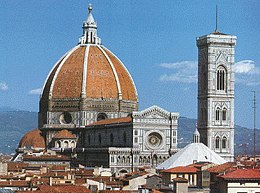 The Dome of the Cathedral in Florence, Italy
“Filippo Brunelleschi was a goldsmith (who had no training in architecture or building). Secretive about how he could build the dome without scaffolding, he was nevertheless awarded the job when he agreed to reveal his methods as the work progressed.
“In the modern day, the Italian professor Massimo Ricci tried to figure out how Brunelleschi built the dome. He began with a model tower and dome 1/5th the size of the real one in a local park. Students laid the bricks, but Professor Ricci also called in 4 or 5 master bricklayers from the United States. Below are three architectural secrets of dome construction that Ricci’s team uncovered:
“Secret #1: (which Brunelleschi himself revealed in 1420): If the layers (“courses”) of bricks were laid in level layers all the way around the dome, the thinner layers of intervening mortar would be weak “shear” surfaces. They would give way, and all the bricks above that shear would fall inward, all the way to the floor of the cathedral. To avoid this problem, a vertical brick is laid after every 3 horizontal bricks. The vertical bricks block the horizontal mortar’s lines of weakness. (When you view the whole areas of the dome, you see that this results in a herringbone pattern.)
“Secret #2: The vertical bricks also form stripes that twist down in spirals from the top of the dome to the bottom. These spirals carry the weight of the dome down to its base. (See the faint, dark red spiral line drawn onto the left-hand illustration below.)
“Secret #3: Between the arches, the courses of the horizontal bricks are not level: they dip down in a shallow reverse arch, like the valley between the humps of a two-humped camel. A reverse arch is an architectural or engineering design element characterized by its inverted curvature compared to a traditional arch. We see it as the slight inward curving near the bottoms of the arches. The reverse arch is known to be one of the strongest shapes in engineering. Brunelleschi invented a brilliant way to measure these arches. He drew a circle on the dome’s construction floor, with a series of 8 round arcs around its edge, forming a sort of flower-and-petal design. When a bricklayer’s string was stretched from the edge of these petals, upward and over through the center of the dome, across to the other side, and up to the latest course of brick being laid, the path of the string traces the inverse arch, and this tracing guides the bricklayers.
“It is possible that Brunelleschi did not come up with these ideas on his own. He may have seen and followed the design of a much, much smaller dome, atop a watch tower that had been built years earlier. In any case, using all these secret methods, the dome was completed in just 16 years – and it is still standing and stable today.” (See the book, Brunelleschi’s Dome, by Ross King.)
Pictures & Images in Our Practice of Continuing Creation
The prohibition of images goes back to the Torah’s (Old Testament’s) ‘no images’ commandment (Exodus 20:4; Deuteronomy 4:15-18). In contrast, divine and semi-divine images play a major role in Buddhism and Hinduism. 1
However, images are okay for Christians. Witness Michelangelo’s Sistine Chapel, which portrays imagined portraits of God, saints, and Jesus, who is considered to be both God and Man.
In Islam, no pictures of Allah (God) are allowed, because He is too great to be captured, portrayed, or described. Even trying to portray Allah is to diminish or limit His greatness. Additionally, Muhammad warned that the use of pictures might lead to idol worship. (Nevertheless, nearly all Muslims would say that God is masculine!)
In Hinduism, there are many representations of the various faces or manifestations of Brahman. But there is no portrait of Brahman itself.
“In Hinduism, Brahman connotes the highest universal principle, the Ultimate Reality of the universe. In the Vedic Upanishads, Brahman constitutes the fundamental reality that transcends the duality of existence and non-existence. It serves as the absolute ground from which time, space, and natural law emerge. It represents an unchanging, eternal principle that exists beyond all boundaries and constraints. Because it transcends all limitations, Brahman ultimately defies complete description or categorization through language.” — Wikipedia
In Philosophical Taoism & in Zen – no portraits or pictures are attempted. Religious Taoism, however, does depict deities and immortals.
Our Essays about Nature’s Continuing Creation do have pictures… but not of a personified God.
A tree can metaphorically represent Nature’s Continuing Creation, and so can a snowflake, an abstract net of connected nodes, a seashell, a spiral galaxy, and a drawing of Gaia or Mother Nature.
Meditations
Meditations are central to the Practice of Nature’s Continuing Creation. We have a separate Essay about them — “Meditations for Nature’s Human Co-Creators.”
Poems
Walt Whitman’s poem, Song of the Open Road, and Black Elk’s Circle Poem could be anthems for Nature’s Path of Natural Creation.
— Song of the Open Road, by Walt Whitman (published in 1856)
“Afoot and light-hearted, I take to the open road,
Healthy, free, the world before me,
The long brown path before me, leading wherever I choose.
“Henceforth I ask not good-fortune, I myself am good-fortune,
Henceforth I whimper no more, postpone no more, need nothing,
Done with indoor complaints, libraries, querulous criticisms,
Strong and content I travel the open road.
“The earth, that is sufficient,
I do not want the constellations any nearer,
I know they are very well where they are,
I know they suffice for those who belong to them.
“(Still here I carry my old delicious burdens,
I carry them, men and women, I carry them with me wherever I go,
I swear it is impossible for me to get rid of them,
I am fill’d with them, and I will fill them in return.)”
— Life is a Circle, by Black Elk, Medicine Man of the Oglala Sioux (1863-1950)
“Everything the power of the world does,
is done in a circle.
The sky is round
and I have heard that the earth
is round like a ball,
and so are all the stars.
The wind in its’ greatest power whirls.
Birds make their nests in circles;
for theirs is the same religion as ours.
The sun comes forth and
goes down again in a circle.
The moon does the same
and both are round.
Even the seasons form a great circle
in their changing
and always come back
to where they were.
The life of a man is a circle,
from childhood to childhood.
and so it is with everything
where power moves.”
— The Bible’s Psalm 23:
Psalm 23: King James Version:
“The LORD is my shepherd; I shall not want.
He maketh me to lie down in green pastures: he leadeth me beside the still waters.
He restoreth my soul: he leadeth me in the paths of righteousness for his name’s sake.
Yea, though I walk through the valley of the shadow of death, I will fear no evil: for thou art with me; thy rod and thy staff they comfort me.
Thou preparest a table before me in the presence of mine enemies: thou anointest my head with oil; my cup runneth over.
Surely goodness and mercy shall follow me all the days of my life: and I will dwell in the house of the LORD forever.”
Psalm 23: Revised by JX Mason for Nature’s Continuing Creation:
“Nature’s Continuing Creation (NCC) is my scaffolding; I shall not fall
NCC anchors my feet and frees my arms
NCC connects me to all that was and is, and guides me toward what shall be.
Although I may build in the valley of the shadow of death, I will fear no destruction, for NCC is with me; Its columns & cables support me.
Nature’s Continuing Creation prepares a loom before me in the presence of my enemies:
Nature’s Continuing Creation shines light upon me; my weave is beautiful and growing.
Surely peace and good works shall flower through me all the days of my life; and I will be part of Nature’s Creation as long as I live.”
Ceremonies In Nature’s Practice of Continuing Creation
- Flower Communion to celebrate love, cooperation, and unity
- Maypole Ceremony to celebrate the rebirth of Spring.
- Tree-planting ceremony, to celebrate Arbor Day, Earth Day.
- Spring equinox to celebrate flowering and rebirth — with bunnies, eggs, and chicks.
- Harvest Festivals at the Autumn Equinox celebrate the bounty of the growing season.
- Winter Solstice marks the passing of the shortest day. It celebrates conception, fertilization, sleep, and hibernation.
- Symbols are hung in an evergreen tree, and a Yule log burns in the fireplace.
- Myriad Ceremonies, celebrating building and creating. Cornerstone-layings, ribbon-cuttings, fireworks.
- Graduation ceremonies to celebrate learning.
- Annual Birthday Celebration(s) for many of the Inspirational People we listed earlier in this Essay.
Symbols Along the Path of Continuing Natural Creation
- The Golden Moebius Strip is the logo for our book about Continuing Creation. It circles and enfolds;
- Yet the Mobius has only one side and one edge, Celebrating patterns & mathematics.
- The Mature Tree is the largest living thing on Earth. It conducts photosynthesis, supporting animal life on the planet.
- As a tree Grows, it Organizes. It has the directions of upward & outward.
- The ancient Taoist Yin-and-Yang Symbol — the dance of opposites that creates patterns and life.
- Water is the chemical basis and medium for all life on Earth, and a symbol of purity.
- The Grand Canyon, the Everglades, the Alps, the Borneo jungle… all the beautiful creations of geologic and biological evolution.
- The whale is the largest mobile creature on Earth, and whales are also social creatures that communicate through language.
- Flowers are among the most beautiful things on Earth, and they are worthy of celebration.
- Earth’s Mineral crystals are also beautiful and worthy of celebration.
- Flowing streams of water represent the Flow of Nature’s Continuing Creation.
- Ecosystems, with their intricate interconnections of creatures and habitats, are worthy of celebration.
- The fabulous Creations of cultural evolution – pyramids, cathedrals, Van Gogh’s art, Beethoven’s Fifth Symphony, the Federalist Papers…
…. All these, and more, are worthy of celebration!
Readings and Sayings
Selected Chapters from the Tao Te Ching (as translated by Stephen Mitchell. (Harper Perrenial, 1988.)
#4, 5, 6, 8, 9, 11, 24, 25, bottom of 30, 33, 34, 37, 39, 63, 68, 73, 74, and #76. (The total number of Chapters in the Tao Te Ching is 81.)
Here are portions of Chapters #9, #11, #39, and #63:
# 9: “Fill your bowl to the brim, and it will spill… do you work, and then step back — the only way to serenity.”
# 11: “We join spokes together in a wheel, but it is the center hole that makes the wagon move.”
# 39: “The Master views the parts with compassion — because He understands the whole.”
# 63: “Confront the difficult while it is still easy; accomplish the great task while it is still small. The Master never reaches for the great, thus She achieves greatness.”
Unitarian-Universalist Readings that Apply to
Nature’s Path of Continuing Creation
(Numbered Sayings and Readings selected from the Unitarian Universalist “Gray” and “Blue” Hymnals.)
417. For the Beauty of the Earth. — Barbara Pescan
419. Look to This Day. — Attributed to Kalidasa
420. We are Here to Abet Creation. — Annie Dillard
518. Grandfather, Look at Our Brokenness. — Ojibway Indians of North America
524. Earth Mother, Star Mother. — Starhawk
525. Web, Intricate & Untraceable — Denise Levertov
537. Our Whole System — Maria Mitchell
550. We Belong to the Earth — Attributed to Chief Noah Sealth
551. Earth Teach Me Stillness — from the Ute Indians of North America
595. Free from Suffering — The Bodhisattva Vows
602. If There Is to Be Peace in the World — Lao Tzu
645. Song of the Open Road — Walt Whitman
649. From Generation to Generation — Antoine de Saint-Exupéry
650. Cherish Your Doubts — Robert T. Weston
660. To Live Deliberately — Henry David Thoreau
Unitarian-Universalist Hymnal’s Songs & Music
(Remember, these are J.X. Mason’s personal favorites. You may prefer others.)
Numbered songs from Singing the Living Tradition, published by The Unitarian Universalist Association, 1993.
16. ‘Tis a Gift to Be Simple
21. For the Beauty of the Earth
38. Morning Has Broken
163. For the Earth Forever Turning
188. Come, Come, Whoever You Are
194. Faith Is a Forest
203. All Creatures of the Earth and Sky
235. Deck the Halls with Boughs of Holly
288. All Are Architects
290. Creative Love, Our Thanks We Give
314. We Are Children of the Earth
1064. Blue Boat Home
1067. Mother Earth, Beloved Garden
Commercial, Copyrighted Songs & Music
“I Write the Songs“ (written by Bruce Johnston, recorded by Barry Manilow)
And I wrote the very first song
I put the words and the melodies together
I am music, and I write the songs
“I write the songs that make the whole world sing
I write the songs of love and special things
I write the songs that make the young girls cry
I write the songs, I write the songs
“My home lies deep within you
And I’ve got my own place in your soul
Now, when I look out through your eyes
I’m young again, even though I’m very old…
“Oh, my music makes you dance
And gives you spirit to take a chance!
And I wrote some rock ‘n’ roll, so you can move!
Music fills your heart, well, that’s a real fine place to start
It’s from you, it’s from me
It’s a worldwide symphony!
I am Music, and I write the songs!”
Of course, “Music” is not a real person; it is a literary personification of music. Humans actually write and sing music, and so do whales. And birds (or bird species). In this book about Nature’s Continuing Creation, we discuss a larger, overarching personification known as Mother Nature, or Gaia. Mother Nature or Gaia is the personification of all the Creative Processes of Nature, including respiration, patterning, flowering, reproduction, sexual mating, and fruiting. We again refer the reader to Professor Richard O. Prum’s best-selling book, “The Evolution of Beauty: How Darwin’s Theory of Mate Choice Shapes the Animal [and plant] World — and Us.” — JXM
“Calypso,” by John Denver. (Celebrating the environmental work of Jacques Cousteau’s ship, The Calypso)
“To sail on a dream on a crystal-clear ocean
To ride on the crest of a wild, raging storm
To work in the service of life and living
In search of the answers to the questions unknown
To be part of the movement and part of the growing
Part of beginning to understand
“Aye Calypso, the places you’ve been to
The things that you’ve shown us
The stories you tell
Aye Calypso, I sing to your spirit
The men who have served you so long and so well
“Like the dolphin who guides you, you bring us beside you
To light up the darkness and show us the way
For though we are strangers in your silent world
To live on the land, we must learn from the sea
To be true as the tide and free as a wind swell
Joyful and loving in letting it be
“Aye, Calypso, the places you’ve been to
The things that you’ve shown us
The stories you tell
Aye, Calypso, I sing to your spirit
The men who have served you so long and so well”
— Words and music by John Denver. First appeared on the album, Windsong (1975)
https://lyricstranslate.com/en/john-denver-calypso-lyrics.html
Other Songs by Various Composers and Performers
The Blue Danube Waltz
Imagine No Religion (John Lennon)
Pipeline (musical depiction of surfing the tunnels of giant, breaking waves)
Galway Bay
Rocky Mountain High
Vivaldi’s Four Seasons
The Grand Canyon Suite (Ferde Grofe)
Sunshine On My Shoulders (John Denver)
Big Yellow Taxi (Joni Mitchell)
Gaia (James Taylor)
Back to The Earth (Jason Mraz)
Georgia On My Mind (Ray Charles)
Still, Still, Still
Claire de Lune
Moonlight Sonata
Bali Hai (from the musical, South Pacific)
Adventures in Paradise (theme)
Southern Cross (Crosby, Stills & Nash)
Terlinga Sky (Gary P. Nunn)
Harvest Moon (Neil Young)
Out of Africa (theme)
What a Wonderful World
Born On The Bayou
The Three R’s (Jack Johnson)
Goin’ Up Country
Earth Day Everyday (John Denver)
Mother Earth (a blues song by Tracy Nelson)
Turn, Turn, Turn
Old Man River
Shenandoah
Morning Has Broken
On The Wings of an Eagle (John Denver)
From A Distance (Bette Midler, other artists)
Swan Lake
Night on Bald Mountain
I love Paris
Wreck of the Edmund Fitzgerald
America The Beautiful
Oh, What a Beautiful Morning!
Oklahoma!
Autumn In New York
Rhythm & Dance, Ceremony & Ritual
Births, birthdays, weddings, anniversaries, Memorial Services (funerals)… and the ceremonial dances of indigenous peoples around the world.
Humans like rhythm and ritual. Even the earliest societies and cultures have them.
In Hinduism, the God Shiva is said to “dance the world into existence.” Sufi Islam has the dance of the whirling dervishes. And the dances of tribal Africans and Native Americans. Fundamentally, all these dances, these rhythms, celebrate the dance between matter and energy, between wave and particles and fields (particles are quantum variations in space-time). They also celebrate the relationships between the elements of ecosystems and the relationships between people. Honeybees do dances to communicate the locations of flowers with nectar. Human Dances may even echo the dance among galaxies, gas clouds, and black holes.
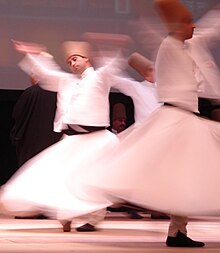 Sufi Whirling Dances (popularly known as ‘Whirling Dervish’ Dances)
In this Essay, we’ve used a lot of “ink” writing about possible Gatherings, Songs, Sayings, & Inspirational people.
Next, we strongly encourage you to read our two final Essays, re-telling two actual presentations from two actual inspirational people:
> “4,000 Years of Christmas,” presented by Ms. Laura Emerson…. and
> “Primal Reverence,” written and presented by The Reverend Kendyl Gibbons
_________________________________